
Brephidium
Scudder, 1876
pygmy blues
Species Guides
2- Brephidium exilis(Western Pygmy Blue)
- Brephidium pseudofea(Eastern Pygmy-Blue)
Brephidium is a of butterflies in the Lycaenidae, commonly known as pygmy blues. The genus contains three with a striking disjunct distribution: two species occur in the Americas (Brephidium exilis and Brephidium pseudofea), while the third (Brephidium metophis) is found in southern Africa. These are among the smallest butterflies in the world, with Brephidium exilis being the smallest in North America.
Pronunciation
How to pronounce Brephidium: //brɛˈfɪdiˌʊm//
These audio files are automatically generated. While they are not always 100% accurate, they are a good starting point.
Identification
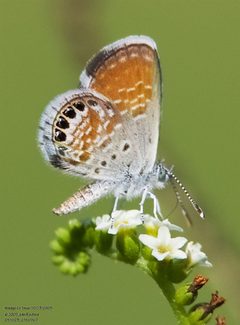
Distinguished from other Lycaenidae by their exceptionally small size combined with blue coloration. In North America, separated from other blues by smaller stature and preferences. Brephidium exilis (western pygmy blue) has more extensive orange marginal markings on hindwing underside than B. pseudofea (eastern pygmy blue). African B. metophis has different wing pattern details. Critical separation from similar small lycaenids requires examination of genitalia or detailed wing pattern analysis.
Images
Appearance
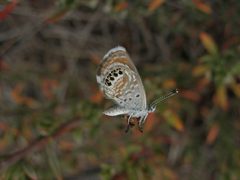
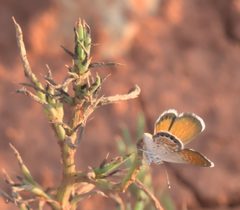
Extremely small butterflies with wingspans typically under 20 mm. Upperwing surfaces are blue to blue-gray with variable dark markings. Underwings are grayish with small dark spots and often show a metallic sheen. The diminutive size is the most distinctive feature, with frequently overlooked due to their tiny stature.
Habitat
varies by . Brephidium exilis occupies arid and semi-arid regions including deserts, salt flats, and disturbed areas; has been observed in sand dune habitats, riparian areas, and even forested areas at atypical elevations in the Arabian Peninsula. Brephidium pseudofea is restricted to salt marshes and coastal salt flats in the southeastern United States where plants grow. Brephidium metophis occurs in southern African savanna and grassland habitats.
Distribution
Disjunct distribution across three continents. Brephidium exilis: southern United States through Mexico to South America, with recent records from the Arabian Peninsula (Saudi Arabia) suggesting expanding range or human-assisted . Brephidium pseudofea: southeastern United States (coastal areas from Texas to Florida). Brephidium metophis: South Africa, Namibia, Botswana, Mozambique, and Zimbabwe.
Seasonality
active year-round in warm southern portions of range; peak activity varies regionally. In temperate North American areas, active primarily spring through fall with multiple . Activity patterns tied to plant availability and rainfall in arid .
Diet
Larval stages feed on succulent plants, particularly in the Amaranthaceae (including saltbushes in Atriplex for B. pseudofea). feed on nectar from small flowers.
Host Associations
- Atriplex - larval Saltbushes, primary for B. pseudofea in southeastern US salt marshes
- Suaeda - larval Sea-blites, reported plants
- Salsola - larval Russian thistle and related
Life Cycle
Complete with , larva, pupa, and stages. Larvae are slug-like, typical of Lycaenidae, and feed on plant foliage. occurs in debris or on host plants. Multiple per year in favorable climates.
Behavior
fly low to the ground and frequently rest with wings closed, showing the cryptic gray underwings. Rapid, erratic pattern when disturbed. Often overlooked due to small size and tendency to remain near ground vegetation.
Ecological Role
of small flowers in arid and coastal . Larval herbivores on salt-tolerant vegetation, contributing to nutrient cycling in specialized . Serve as prey for various including birds, spiders, and predatory insects.
Human Relevance
Subject of scientific interest due to extreme small size and disjunct . Brephidium exilis has become a model for studying and following recent Arabian Peninsula records. No significant economic impact; occasionally observed in butterfly gardens and nature tourism in appropriate .
Similar Taxa
- HemiargusSmall blue lycaenids with similar coloration; distinguished by larger size, different underwing patterns, and preferences
- EchinargusSmall blue butterflies including Reakirt's blue; separated by wing pattern details and lack of extreme size reduction
- LeptotesMarine blue and relatives; similar small size but different wing shape and pattern, particularly on underwings
More Details
Biogeographic significance
The disjunct distribution of Brephidium, with in the Americas and Africa but absent from intervening regions, has been of historical interest to biogeographers. The recent discovery of B. exilis in the Arabian Peninsula suggests either long-distance natural or human-mediated introduction, with potential for further spread into North Africa and the Mediterranean.
Size records
Brephidium exilis is recognized as the smallest in North America and among the smallest in the world, with wingspans sometimes under 12 mm. This extreme miniaturization presents challenges for study and identification in the field.
Sources and further reading
- BugGuide
- Wikipedia
- GBIF taxonomy match
- iNaturalist taxon
- NCBI Taxonomy
- Catalogue of Life
- Got a Question About Butterflies? | Bug Squad
- Bug Eric: September 2010
- Coreidae | Beetles In The Bush | Page 2
- Scathophagidae | Beetles In The Bush
- Habitat: Brephidium pseudofea (Lycaenidae)
- Notes on the biology of Brephidium exilis (Boisduval) (Lycaenidae)
- Eastern Pigmy Blue, Brephidium isophthalma pseudofoea (Morrison) (Insecta: Lepidoptera: Lycaenidae)
- A new locality and larval host plant recorded for <i>Brephidium exilis exilis<i> (Boisduval, 1852) on the Arabian Peninsula
- First records of Brephidium exilis (Boisduval) (Lepidoptera: Lycaenidae) from south-western part of the Arabian Peninsula suggests possible further dispersal into North Africa