
Lycaena hyllus
(Cramer, 1775)
bronze copper
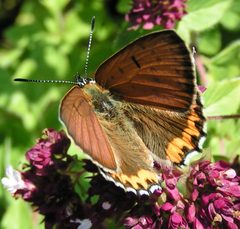
Lycaena hyllus, the bronze , is a North American lycaenid with distinctive bronze and golden wing markings. The ranges widely across western and eastern North America, from Alberta to the Atlantic coast. Larvae feed on Polygonaceae plants including docks and water smartweeds, while nectar on flowers such as blackberry and red clover. The species is listed as a species of special concern in Connecticut.
Pronunciation
How to pronounce Lycaena hyllus: //laɪˈsiːnə ˈhɪləs//
These audio files are automatically generated. While they are not always 100% accurate, they are a good starting point.
Identification
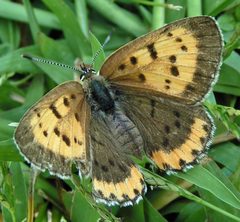
Distinguished from similar coppers by the combination of brown upperside with golden zig-zag hindwing borders and white underside with orange underlay. Females are identifiable by lighter forewing patches with dark spotting. Similar in range to Lycaena heteronea in Alberta, but differs in wing pattern details.
Images
Appearance
Wingspan 23–38 mm. Upperside brown with golden zig-zag borders along hindwing margins. Females have lighter forewing areas containing several dark spots. Underside primarily white with dark spots and underlying orange areas.
Habitat
Associated with wetland and riparian areas where plants of Polygonaceae occur, including water dock and curled dock .
Distribution
Widespread across North America from Alberta and northern Nevada westward through to the east coasts of Canada and the United States. Present in Alberta, Manitoba, and Saskatchewan in Canada.
Diet
Larvae feed on plants of Polygonaceae: water dock (Rumex hydrolapathum), curled dock (Rumex crispus), and Persicaria amphibia. have been observed feeding on blackberry (Rubus) and red clover (Trifolium pratense).
Host Associations
- Rumex hydrolapathum - larval water dock
- Rumex crispus - larval curled dock
- Persicaria amphibia - larval water smartweed
Human Relevance
Listed as a of special concern in the US state of Connecticut.
Similar Taxa
- Lycaena heteroneaOverlapping range in Alberta, distinguished by wing pattern differences
More Details
Conservation status
Listed as of special concern in Connecticut
Sources and further reading
- BugGuide
- Wikipedia
- GBIF taxonomy match
- Mary Louise Flint's Article in The Acorn: 'Butterflies in Decline' | Bug Squad
- 'Climate Change' May Be a Key Factor in Declining Butterfly Populations | Bug Squad
- Over a century later, the mystery of the Alfred Wallace’s butterfly is solved | Blog
- Grassland butterflies: important indicators of the state of nature