
Hesperopsis libya
(Scudder, 1878)
Mojave sootywing, Mohave sootywing, Great Basin sootywing, Lena sooty wing
A small of the Hesperiidae, found in arid regions of western North America. have a wingspan of 22–32 mm and exhibit variable periods depending on latitude, with multiple in southern California and single generations in northern parts of the range. The is tightly associated with saltbush (Atriplex) plants in alkaline desert environments.

Pronunciation
How to pronounce Hesperopsis libya: /hɛˈspɛrəpɪs ˈlɪbiə/
These audio files are automatically generated. While they are not always 100% accurate, they are a good starting point.
Identification
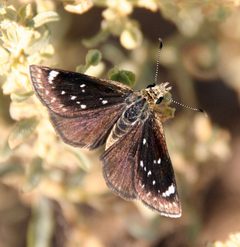
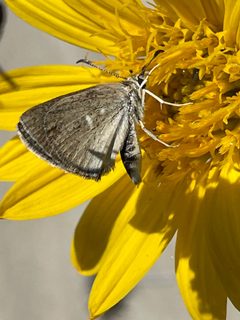
Small dark skipper with sooty brown to blackish wings; distinguished from similar dark skippers by preference for alkaline flats and association with Atriplex plants. The combination of small size (22–32 mm wingspan), dark coloration, and presence in sagebrush desert or alkali flat environments helps separate it from co-occurring skipper .
Images
Habitat
Alkaline flats, sagebrush desert, desert hills, shale barrens, watercourses, and ravines. Strongly associated with arid, often saline environments where plants grow.
Distribution
North America from eastern Oregon east to Montana and south to southern California, Arizona, and north-western Mexico including Baja California.
Seasonality
Highly variable by region: March–October in multiple in California; June–August with two generations in Colorado; July–August in single generation in North Dakota and Montana.
Diet
Larvae feed on leaves of Atriplex canescens (fourwing saltbush) and Atriplex confertifolia (shadscale). feed on flower nectar.
Host Associations
- Atriplex canescens - larval plantlarvae feed on leaves
- Atriplex confertifolia - larval plantlarvae feed on leaves
Life Cycle
Larvae live in nests of leaves tied together with silk. One to multiple per year depending on latitude and elevation.
Behavior
Larvae construct silk-tied leaf nests for shelter. nectar at flowers.
Ecological Role
Herbivore in arid shrubland ; larvae consume saltbush foliage, potentially contributing to nutrient cycling in these environments.
Similar Taxa
- Other Hesperopsis speciesSame ; would require examination of genitalia or detailed wing pattern analysis for separation
- Dark-colored Hesperiidae in arid WestSimilar sooty appearance; specificity and plant association are key distinguishing features