
Amblyscirtes carolina
(Skinner, 1892)
Carolina Roadside-Skipper, Carolina roadside skipper
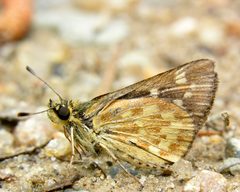
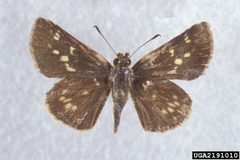
Amblyscirtes carolina is a small in the Hesperiidae, commonly known as the Carolina roadside skipper. It occurs in the southeastern United States with scattered extending northward and westward. are active from spring through late summer with multiple per year. The has a wingspan of 29–37 mm and is associated with moist where its larval plant grows.
Pronunciation
How to pronounce Amblyscirtes carolina: /ˌæm.blɪˈsɜr.tiːz ˌkɛə.rəˈlaɪ.nə/
These audio files are automatically generated. While they are not always 100% accurate, they are a good starting point.
Identification
Distinguished from other Amblyscirtes by its restricted southeastern distribution and preferences. The combination of small size (29–37 mm wingspan), three per year, and association with switchcane (Arundinaria tecta) habitats helps separate it from similar roadside skippers. Disjunct in Delaware, southern Illinois, and northwest Arkansas may represent isolated occurrences requiring verification.
Images
Appearance
Small with wingspan of 29–37 mm. have the typical rapid, darting characteristic of skippers. Wing coloration and pattern details are not explicitly described in available sources.
Habitat
Moist areas supporting switchcane (Arundinaria tecta), the probable larval plant. include roadside edges, wet meadows, and streamside vegetation in the southeastern coastal plain and adjacent regions.
Distribution
Southeastern Virginia south to South Carolina, west to northern Mississippi. Disjunct recorded in Delaware, southern Illinois, and northwest Arkansas. The occupies the Atlantic coastal plain and extends into adjacent physiographic provinces.
Seasonality
active from April to September. Three per year with overlapping periods throughout the warm season.
Diet
Larvae probably feed on Arundinaria tecta (switchcane). feed on flower nectar of sweet pepperbush (Clethra alnifolia), swamp milkweed (Asclepias incarnata), cinquefoil (Potentilla), wild strawberry (Fragaria), blackberry (Rubus), and ironweed (Vernonia).
Host Associations
- Arundinaria tecta - probable larval Switchcane; larval feeding inferred from association and congeneric use patterns
Life Cycle
Three per year. laid on or near plant. Larvae feed on host plant foliage. occurs in sheltered locations. emerge and feed on nectar before mating and oviposition. stage not explicitly documented but likely as pupae or late-instar larvae.
Behavior
exhibit rapid, skipping typical of the Hesperiidae. Multiple produce continuous adult presence during the growing season. No specialized behavioral observations documented beyond general skipper activity patterns.
Ecological Role
function as while feeding on nectar from diverse flowering plants. Larvae are herbivores that consume native bamboo (Arundinaria tecta), contributing to nutrient cycling in wetland and riparian . The serves as prey for including birds and .
Human Relevance
Minor significance as a native in southeastern wetland . Not known to be of economic importance. may be observed by enthusiasts in appropriate habitats during the warm season.
Similar Taxa
- Other Amblyscirtes speciesSimilar small size and rapid ; distinguished by distribution, specificity, and number of per year
- Roadside skippers in genus ThorybesSimilar and use; distinguished by wing pattern details and larval plant associations
More Details
Taxonomic Note
The was originally described as Pamphila carolina by Skinner in 1892. Some sources list it under the Mastor as a synonym, reflecting historical taxonomic revisions within the Hesperiidae.
Sources and further reading
- BugGuide
- Wikipedia
- GBIF taxonomy match
- iNaturalist taxon
- NCBI Taxonomy
- Carolina Grasshopper
- Death of a lanternfly, Part 2: Lanternfly on the Thanksgiving menu for a gal called Carolina – Carolina mantis, Stagmomantis carolina — Bug of the Week
- Surviving winter, Part III: Egg cases of the Praying mantis, Mantis religiosa, Chinese mantis, Tenodera sinensis, and Carolina mantis, Stagmomantis carolina — Bug of the Week
- Decorations on the Christmas tree: Egg cases of the European mantis, Mantis religiosa, Chinese mantis, Tenodera sinensis, and Carolina mantis, Stagmomantis carolina — Bug of the Week
- Exciting But Dreadful: New Invasive Forest Pest Arrives in South Carolina
- Decorations on the Christmas tree: Egg cases of the European mantis, Mantis religiosa, Chinese mantis, Tenodera sinensis, and Carolina mantis, Stagmomantis carolina — Bug of the Week