
Urbanus evona
Evans, 1952
Turquoise Longtail
Urbanus evona is a of ( Hesperiidae) described by Evans in 1952. Commonly known as the Turquoise Longtail, this Neotropical species belongs to a characterized by elongated hindwing tails. The species is part of the Pyrginae, a diverse group of spread-winged skippers. Available distributional records suggest occurrence in Central and South American regions, though detailed biological studies remain limited.
Pronunciation
How to pronounce Urbanus evona: /ˈʊr.bə.nəs ɛˈvoʊ.nə/
These audio files are automatically generated. While they are not always 100% accurate, they are a good starting point.
Identification
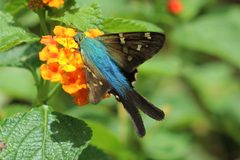
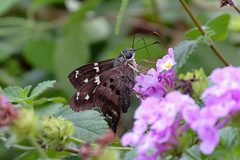
Urbanus evona can be distinguished from congeneric by its specific turquoise coloration and wing pattern details. Accurate identification requires examination of the precise arrangement and extent of blue-green scaling on the wing surfaces, as well as the shape and length of the hindwing tail. Genital dissection or molecular analysis may be necessary to confirm identification where sympatric with similar Urbanus species such as U. proteus (Long-tailed Skipper) or U. dorantes (Dorantes Longtail).
Images
Appearance
As a member of the Urbanus, U. evona possesses the characteristic long, slender hindwing tail that gives the group its . The 'turquoise' epithet suggests blue or blue-green coloration on the upper wing surfaces. Skippers in this genus typically have a robust, -like body with large and relatively short that terminate in hooked clubs. Wing patterns generally include dark brown or black bases with contrasting pale or iridescent markings.
Habitat
Specific preferences for U. evona are poorly documented. Related Urbanus occupy tropical and subtropical open habitats including forest edges, clearings, gardens, and disturbed areas where larval plants occur.
Distribution
Recorded from Central and South America; precise range boundaries require further documentation. The Urbanus is primarily Neotropical in distribution.
Seasonality
activity patterns are not well documented for this . In tropical regions where it occurs, adults may be present year-round with peaks during wet seasons.
Diet
feed on nectar from flowers. Larval plants are not confirmed for U. evona specifically; related Urbanus feed on various legumes (Fabaceae) including beans (Phaseolus) and other herbaceous plants.
Host Associations
- Fabaceae - larval inferred from -level associations; not confirmed for U. evona specifically
Life Cycle
Complete with , larva, pupa, and stages. Specific developmental details for U. evona are not documented. Larvae of related construct leaf shelters by folding or rolling plant leaves.
Behavior
exhibit rapid, darting characteristic of skippers. Perching on vegetation with wings partially open is typical of Pyrginae. Males may establish territories and engage in rapid pursuit of intruders.
Ecological Role
function as when visiting flowers. Larvae serve as herbivores and prey for and . The contributes to local biodiversity in Neotropical .
Human Relevance
Limited documented interaction. Related Urbanus occasionally reach pest status on cultivated beans, but U. evona is not specifically implicated in agricultural damage. Observed by naturalists and enthusiasts.
Similar Taxa
- Urbanus proteusSimilar long-tailed appearance and overlapping distribution; distinguished by wing pattern details and extent of blue coloration
- Urbanus dorantesSympatric in many regions; requires careful examination of wing markings and tail for separation
More Details
Taxonomic note
The epithet 'evona' was established by Evans in 1952. The Urbanus has undergone taxonomic revision, with some former species now placed in related genera.