
Urbanus doryssus
(Swainson, 1831)
White-tailed Longtail
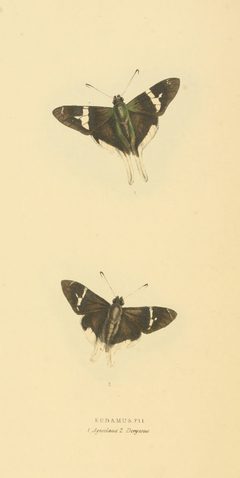
Urbanus doryssus is a of in the Hesperiidae, distributed across the Americas from the southern United States through Central and South America. The species belongs to a characterized by long, slender hindwing tails. Like other members of Urbanus, it exhibits rapid, darting patterns typical of the skipper group. The species was originally described by Swainson in 1831 under the basionym Eudamus doryssus.
Pronunciation
How to pronounce Urbanus doryssus: //ˈʊr.bə.nəs ˈdɒr.ɪ.səs//
These audio files are automatically generated. While they are not always 100% accurate, they are a good starting point.
Identification
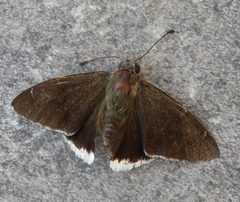
Distinguished from other Urbanus by the white or pale-tipped hindwing tails, referenced in its . The combination of long tails, brown ground color, and specific wing markings separates it from similar long-tailed skippers like Urbanus proteus (Long-tailed Skipper). Accurate identification to species level typically requires examination of genitalia or detailed wing pattern analysis.
Images
Appearance
possess elongated hindwing tails, a defining feature of the . The wings are generally brown with lighter markings; the "White-tailed Longtail" refers to pale tail tips. Wing shape is triangular with relatively short forewings compared to the elongated hindwing tails. Body is robust and -like, typical of skippers. are widely separated at the base and terminate in hooked clubs.
Habitat
Occupies tropical and subtropical environments including forest edges, open woodlands, and disturbed areas with plant availability. Found from lowland to mid-elevation zones where larval host plants in the Fabaceae occur.
Distribution
Widespread across the Americas: present in North America (southern United States), Middle America (Mexico through Central America), and South America. Specific records include Parque Nacional Natural Serranía de Chiribiquete in Colombia.
Seasonality
are active year-round in tropical portions of the range; activity peaks during warmer months in subtropical and temperate areas at the northern range limit.
Diet
feed on nectar from flowers. Larvae feed on plants in the Fabaceae, including various legumes.
Host Associations
- Fabaceae - larval plantLarvae feed on various legume
Life Cycle
Complete with , larva, pupa, and stages. Larvae construct leaf shelters by folding or rolling leaves of plants. occurs within these shelters.
Behavior
exhibit rapid, darting characteristic of skippers, with quick wing beats and sudden directional changes. Males perch to await females and engage in rapid aerial pursuits. Adults frequently visit flowers for nectar.
Ecological Role
function as during nectar feeding. Larvae serve as herbivores, consuming legume foliage and potentially contributing to nutrient cycling in their . Both life stages provide food for including birds, spiders, and .
Human Relevance
are occasional visitors to gardens and -attracting plantings. The has no documented economic impact as either pest or beneficial insect. Larval damage to cultivated legumes appears minimal.
Similar Taxa
- Urbanus proteusLong-tailed Skipper shares elongated hindwing tails and general brown coloration; distinguished by tail coloration and specific wing pattern details
- Urbanus dorantesDorantes Longtail overlaps in range and ; requires close examination of wing markings and tail characteristics for separation
More Details
Taxonomic history
Originally described as Eudamus doryssus by Swainson in 1831; later transferred to Urbanus. The genus Urbanus has undergone taxonomic revision, with historically placed in related genera including Eudamus.
Etymology
The specific epithet "doryssus" derives from Greek, relating to a spear or lance, likely referencing the elongated, pointed hindwing tails.