
Spathilepia clonius
(Cramer, 1775)
Falcate Skipper
Spathilepia clonius, commonly known as the Falcate Skipper, is the sole in the Spathilepia within the skipper Hesperiidae. This ranges from the southern United States through Central America and into South America as far as Argentina. It is a member of the Eudaminae, a group characterized by their robust bodies and rapid, darting patterns. The species has been documented across diverse tropical and subtropical .
Pronunciation
How to pronounce Spathilepia clonius: //ˌspæθɪˈlɛpiə ˈkloʊniəs//
These audio files are automatically generated. While they are not always 100% accurate, they are a good starting point.
Identification
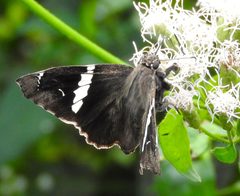
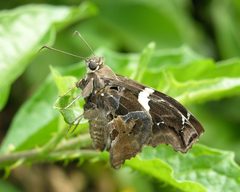
The falcate (curved or sickle-shaped) hindwing margin is the most distinctive field mark, separating this from all other New World skippers. The combination of dark brown ground color with reduced pale spotting, robust body, and rapid distinguishes it from superficially similar urbanus skippers and other eudamine . The hooked clubs confirm placement in Hesperiidae. In the United States, it is the only skipper with strongly falcate hindwings; in the tropics, careful examination of wing shape and spot pattern separates it from other falcate-winged skippers in different genera.
Images
Appearance
Medium-sized skipper with wings showing a distinctive falcate (sickle-shaped) outer margin on the hindwing, giving the its . Upper wing surfaces are dark brown with variable pale spots and bands. Forewings typically display small, light-colored spots arranged in a loose band. Hindwings have a more uniform dark ground color with reduced spotting. The body is robust and densely scaled, typical of hesperiids. are relatively short with hooked clubs. Sexes are similar in general appearance, with minor differences in spot intensity.
Habitat
Occupies tropical and subtropical open including forest edges, clearings, secondary growth, and disturbed areas. In the northern part of its range, found in subtropical thorn scrub and riparian corridors. frequent sunny areas with low vegetation and flowering plants. Larval plants grow in similar open, sunny conditions.
Distribution
Ranges from southern Texas (USA) south through Mexico and Central America to Colombia, Venezuela, and continuing through the Amazon basin to Brazil, Paraguay, and northern Argentina. Present on both Caribbean and Pacific slopes of Central America. Distribution is continuous through the lowland tropics with local abundance varying by season and availability.
Seasonality
are active year-round in tropical portions of the range. In subtropical areas (southern Texas), peak activity occurs from late summer through fall (August–November), with occasional records in other months. Multiple occur annually in most of the range.
Behavior
exhibit the rapid, erratic, darting characteristic of hesperiid skippers. Frequently perch on low vegetation with wings partially open. Males establish territories in open sunny areas and perch on prominent lookout points to intercept females. Adults visit flowers for nectar, with a preference for small, clustered flowers. Rapid escape flight when disturbed, often disappearing into dense vegetation.
Ecological Role
function as when visiting flowers. Larval is poorly documented but likely involves herbivory on specific plants in the Fabaceae. Serves as prey for insectivorous birds, lizards, and other throughout its range.
Human Relevance
Occasionally encountered by watchers in southern Texas, where it is a sought-after due to its distinctive wing shape and relative scarcity in the USA. No significant economic importance. Not known to be threatened or of conservation concern across most of its broad range.
Similar Taxa
- Urbanus spp.Some Urbanus skippers have notched or tailed hindwings but lack the strongly falcate (sickle-shaped) margin; they also tend to have more extensive pale spotting and longer, more slender bodies.
- Chioides spp.Long-tailed skippers have extended hindwing tails rather than a falcate margin, and typically show bold white or pale bands across both forewings and hindwings.
- Polygonus leo (Hammock Skipper)Has somewhat angled hindwing margins but not truly falcate; also shows more extensive pale markings and a different overall wing shape.
More Details
Taxonomic history
Originally described as Papilio clonius by Cramer in 1775, this was later transferred to the Spathilepia established to accommodate its unique combination of morphological features, particularly the distinctive wing shape and genitalic characters that separate it from related eudamine genera.
Etymology
The specific epithet 'clonius' derives from Greek mythology; the name Spathilepia refers to the spatulate (spoon-shaped) or falcate wing characteristics.