
Cogia
Butler, 1870
Pyramid Skippers
Species Guides
4- Cogia caicus(Gold-costa Skipper)
- Cogia calchas(mimosa skipper)
- Cogia hippalus(Acacia Skipper)
- Cogia outis(Outis Skipper)
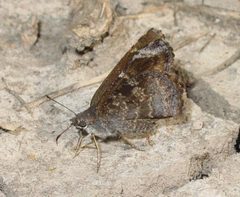
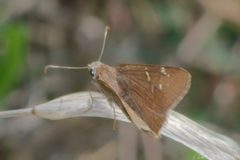
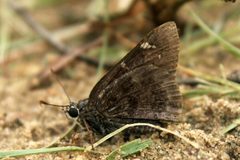
Cogia is a of Neotropical skippers in the Hesperiidae, Eudaminae, commonly known as Pyramid Skippers. The genus contains approximately 22 described distributed across the Americas, from the southwestern United States through Mexico, Central America, and into South America. Larvae are associated with leguminous plants, particularly species in the genus Senna (Fabaceae), and construct shelters from host plant leaflets.
Pronunciation
How to pronounce Cogia: //ˈkoʊ.d͡ʒi.ə//
These audio files are automatically generated. While they are not always 100% accurate, they are a good starting point.
Identification
Males of most Cogia possess a hair tuft on the hindwing; however, C. aventinus, C. buena, and C. mala lack this feature. Male genitalia are similar among these three species and serve as a primary diagnostic character for distinguishing them from . Wing patterns vary among species but generally exhibit the characteristic skipper with hooked clubs.
Images
Habitat
Cloud forest at elevations of 1470–2000 m in the Sierra Madre del Sur of Oaxaca, Mexico (documented for C. buena). Urban park settings have been recorded in Curitiba, Paraná, Brazil (for C. stylites). Broader habitat associations across the likely include tropical and subtropical forested environments given the Neotropical distribution.
Distribution
Neotropical region, ranging from the southwestern United States through Mexico, Central America, and South America. Specific documented localities include: Sierra Madre del Sur, Oaxaca, Mexico (C. buena, ); Curitiba, Paraná, Brazil (C. stylites). The as a whole spans the Americas with highest diversity in tropical zones.
Diet
Larvae feed on Fabaceae (Leguminosae), including Acacia, Indigofera, Mimosa, and Senna. Specific records include Senna multijuga subsp. lindleyana var. lindleyana for C. stylites. Larvae of C. stylites have been observed using host plant leaflets for both food and shelter construction. diet is unknown.
Host Associations
- Senna multijuga subsp. lindleyana var. lindleyana - larval First record for C. stylites; Fabaceae: Caesalpinioideae
- Senna Mill. - larval -level association; shared with congeneric and related genus Typhedanus
- Acacia - larval Fabaceae; general record
- Indigofera - larval Fabaceae; general record
- Mimosa - larval Fabaceae; general record
- Milicia - larval Moraceae; general record
Life Cycle
Larval stage constructs shelters using leaflets from the plant. specimens have been found inside these shelters. Specific details regarding , pupal, and stages are not documented in available sources.
Behavior
Larval shelter construction using plant leaflets is a documented for at least C. stylites. This behavior may be shared with other congeneric given the close phylogenetic relationships and similar host plant associations, though this remains to be confirmed.
Similar Taxa
- TyphedanusClosely related sharing specific plant associations with Senna ; phylogenetically proximate within Eudaminae
- Cogia malaClosely related to C. buena and C. aventinus; all three uniquely lack the male hindwing hair tuft present in other Cogia species
- Cogia aventinusClosely related to C. buena and C. mala; all three uniquely lack the male hindwing hair tuft present in other Cogia species
More Details
Taxonomic history
The was established by Butler in 1870. -level has been refined through works by Evans (1952, 1953), Hayward (1947), and Mielke (1967, 1979), with more recent descriptions including C. buena from Mexico.
Nomenclatural note
The name Cogia is feminine in gender, affecting epithet endings accordingly.