
Codatractus alcaeus
(Hewitson, 1867)
White-crescent Longtail
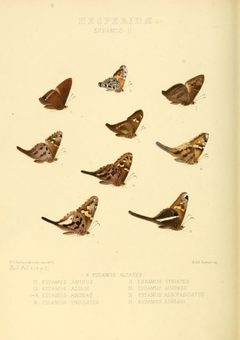
Codatractus alcaeus is a in the Hesperiidae, commonly known as the White-crescent Longtail. The was described by William Chapman Hewitson in 1867 from specimens originating in Central America. It belongs to the Pyrginae, a group characterized by robust bodies and rapid, darting . The refers to diagnostic white markings on the wings.

Pronunciation
How to pronounce Codatractus alcaeus: /koʊdəˈtræktəs ælˈsiːəs/
These audio files are automatically generated. While they are not always 100% accurate, they are a good starting point.
Identification
The White-crescent Longtail is distinguished from similar longtail skippers by the combination of: (1) white crescent-shaped forewing markings rather than continuous bands or spots, (2) relatively unmarked dark hindwing upperside with only small pale marginal spots, and (3) tail length intermediate between very long-tailed (Urbanus) and short-tailed relatives. Separated from Codatractus arizonensis by more extensive white markings and more southerly distribution.
Images
Appearance
Medium-sized skipper with elongated hindwing tails typical of the 'longtail' group. Upper wing surface dark brown to blackish with distinct white crescent-shaped or triangular markings, particularly on the forewing. Hindwing has pale marginal spots. Underside generally paler brown with more extensive light markings. Body stout with large , with hooked clubs.
Habitat
Tropical and subtropical including forest edges, second growth, and disturbed areas with plants. Found from lowland to middle elevations.
Distribution
Ranges from Mexico through Central America to Panama. Present in both Middle America and southern North America (Mexico). Distribution records indicate presence across the Mesoamerican land bridge.
Behavior
Rapid, erratic typical of skippers. perch with wings partially open, hindwings flat and forewings held at angle.
Ecological Role
likely function as ; larvae are herbivores feeding on leguminous plants.
Similar Taxa
- Codatractus arizonensisOverlaps in Mexico but has reduced white markings and more northerly range extension into Arizona
- Urbanus speciesSimilar long-tailed appearance but typically have longer, more slender tails and different wing pattern elements
- Chioides speciesShare long-tailed but have different white marking patterns and often more extensive pale areas
More Details
Etymology
The specific epithet 'alcaeus' refers to Alcaeus, an Ancient Greek lyric poet of Mytilene; the etymological connection to is unclear.
Taxonomic History
Originally described as Eudamus alcaeus by Hewitson in 1867, later transferred to Codatractus based on genitalic and wing venation characters distinguishing it from true Eudamus.