
Clostera inclusa
(Hübner, 1831)
angle-lined prominent moth, many-lined prominent, poplar tentmaker, pipla tentmaker
Clostera inclusa is a small notodontid native to North America, commonly known as the angle-lined prominent or poplar tentmaker. have a wingspan of 25–32 mm. The is multivoltine, producing multiple per year. Larvae are gregarious and feed on Salicaceae species, particularly poplars. The species serves as an important laboratory for rearing the Ooencyrtus ennomophagus.
Pronunciation
How to pronounce Clostera inclusa: /ˈklɔstɛrə ɪnˈkluːsə/
These audio files are automatically generated. While they are not always 100% accurate, they are a good starting point.
Identification
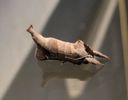
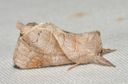
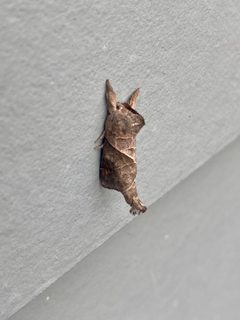
Distinguished from similar prominent moths by the angular line pattern on the forewings. The combination of small size (25–32 mm wingspan), North American distribution, and association with Salicaceae aids identification. Gregarious larval is a notable trait.
Images
Distribution
North America: recorded from Arkansas, Colorado, Florida, Georgia, Illinois, New Hampshire, New York, North Carolina, Oklahoma, Ontario, Oregon, Pennsylvania, South Carolina, and Virginia.
Seasonality
Multivoltine; active across multiple per year. Specific periods vary by region.
Diet
Larvae feed on various Salicaceae , including poplars (Populus spp.).
Host Associations
- Ooencyrtus ennomophagus - Thelyotokous, multivoltine ; C. inclusa serves as factitious for laboratory rearing
Life Cycle
Multivoltine with multiple annually. can be preserved below freezing to maintain unembryonated condition for rearing. Larvae are gregarious.
Behavior
Larvae exhibit gregarious feeding . Communal feeding on plants may contribute to the 'tentmaker' , though specific tent-building behavior is not documented in sources.
Ecological Role
Herbivore on Salicaceae. Serves as for Ooencyrtus ennomophagus, facilitating research and mass culture of entomophagous .
Human Relevance
Used extensively in laboratory research as a factitious for rearing the Ooencyrtus ennomophagus, particularly when field of typical hosts are unavailable. Eggs can be cryopreserved for continuous parasitoid rearing.
Similar Taxa
- Other Clostera speciesShare similar and Salicaceae-feeding habits; require examination of wing pattern details for separation
- Other NotodontidaeMany prominent moths have comparable size and general appearance; angular forewing lines and association distinguish C. inclusa
More Details
Laboratory Significance
C. inclusa became critical for maintaining Ooencyrtus ennomophagus colonies after field crashed in 1979, demonstrating the value of multivoltine factitious for continuous rearing.