
Garella
Walker, 1863
Asian walnut moth (for G. musculana)
Species Guides
1- Garella nilotica(Black-olive Caterpillar Moth)
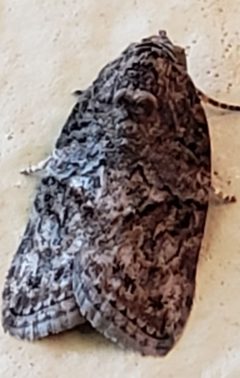
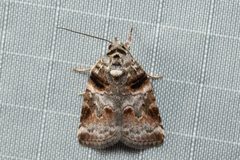
Garella is a of in the Nolidae, established by Walker in 1863. The genus includes at least one significant agricultural pest, Garella musculana (Asian walnut moth), which has expanded from its native Central Asian range into Europe. in this genus are associated with walnut (Juglans) as larval . The genus has become taxonomically contentious, with molecular and morphological evidence suggesting that G. musculana and G. ruficirra may represent a single geographically variable species rather than distinct .
Pronunciation
How to pronounce Garella: /gəˈrɛlə/
These audio files are automatically generated. While they are not always 100% accurate, they are a good starting point.
Images
Distribution
Native to Central Asia (Kazakhstan, Kyrgyzstan, Tajikistan, Turkmenistan, Uzbekistan, India, Jammu and Kashmir). Established in Europe: Bulgaria, Romania, Russia, Southern Russia, Ukraine, Turkey, and more recently Italy (first recorded 2021 in Veneto region). Distribution records also include Vermont, USA, though establishment status there is unclear.
Human Relevance
Garella musculana is a major pest of walnut . Larvae damage young shoots of Juglans regia (common walnut) and J. nigra (black walnut), causing shoot dieback and fruit drop. In Bartın, Turkey, orchard-level damage rates reached 42% with 15% of shoots infested. The ' recent spread into Europe (first Italy 2021, earlier Crimea 2008) represents an emerging phytosanitary concern for walnut-producing regions.
Similar Taxa
- Garella ruficirra (Hampson, 1905)Strong morphological and molecular similarity; COI barcoding shows near-identical sequences. Male terminalia show subtle differences. Geographic distributions are largely parapatric. Current evidence insufficient to confirm specific distinction; may represent single geographically variable .
Sources and further reading
- BugGuide
- Wikipedia
- GBIF taxonomy match
- iNaturalist taxon
- NCBI Taxonomy
- Catalogue of Life
- Garella musculana (Erschov)
- Garella musculana . [Distribution map].
- New Host Walnut Species Juglans nigra For Garella musculana
- THE FIRST PARASITOID RECORD OF GARELLA MUSCULANA (NOLIDAE, LEPIDOPTERA) FROM TURKEY; PIMPLA SPURIA (ICHNEUMONIDAE, HYMENOPTERA)
- Ceviz güvesi Garella musculana (Erschov, 1874) (Lepidoptera: Nolidae)’un morfolojik karakterleri, Bartın ilinde yayılış alanları ve zarar oranı Morphological characters, damage rate and distribution areas of Walnut moth Garella musculana (Erschov, 1874) (Lepidoptera: Nolidae) in Bartın
- First report of Garella musculana (Erschov, 1874) (Lepidoptera: Nolidae) in Italy with insights into its identity
- Biology and damage of Asian walnut moth, Garella musculana (Lepidoptera: Nolidae), a major insect pest of Juglans regia in Kashmir Himalaya
- Supplementary material 1 from: Zanolli P, Scaccini D, Pozzebon A (2023) New insights into the distribution and spreading of the Asian walnut moth, Garella musculana (Erschov, 1874) (Lepidoptera, Nolidae) in Europe with a focus on the Italian range. Biodiversity Data Journal 11: e107609. https://doi.org/10.3897/BDJ.11.e107609