
Plagiomimicus aureolum
(Edwards, 1882)
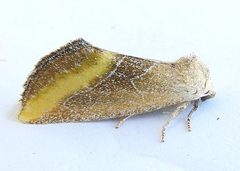
Plagiomimicus aureolum is a small owlet moth in the Noctuidae, described by Henry Edwards in 1882. It is to the southwestern United States, with confirmed records from Arizona, western Texas, and New Mexico. The is characterized by pinkish-brown forewings with whitish flecks and dull fawn hindwings. It is attracted to artificial light sources.
Pronunciation
How to pronounce Plagiomimicus aureolum: //ˌplædʒi.oʊˈmɪmɪkəs ˈɔːriˌoʊləm//
These audio files are automatically generated. While they are not always 100% accurate, they are a good starting point.
Identification
The combination of small size (25–27 mm wingspan), pinkish-brown forewings with whitish flecking, and dull fawn hindwings with pale base distinguishes P. aureolum from other Plagiomimicus . The indistinct line on the hindwings is a useful character. It may be confused with other small noctuids in the Stiriinae, but the specific color pattern of the forewings and hindwings is diagnostic. Dissection of genitalia may be required for definitive identification in some cases.
Images
Appearance
A small with wingspan of 25–27 mm. The two-thirds of the forewings are pinkish-brown with scattered flecks of whitish . The hindwings are dull fawn color, palest at the base, with an indistinct line. The overall coloration is subdued and earthy.
Habitat
Dry, mixed conifer forest with oaks at moderate elevations (around 7,000 feet based on regional records). The occurs in semi-arid to arid environments of the southwestern United States.
Distribution
to southwestern North America. Recorded from Arizona, western Texas, and New Mexico. The distribution is restricted to the Chihuahuan Desert and adjacent montane regions.
Behavior
are attracted to artificial light sources, including blacklights and porch lights. No other behavioral details have been documented.
Human Relevance
No known economic or ecological significance to humans. Occasionally encountered by lepidopterists and naturalists during blacklight surveys.
Similar Taxa
- Plagiomimicus dimidiataSimilar size and general appearance, but P. dimidiata has different forewing pattern and coloration; early life stages unknown for both , making pattern the primary distinguishing feature
- Other Stiriinae generaMany small noctuids in the Stiriinae share similar size and habits, but differ in wing pattern details; genitalia dissection often required for definitive separation
More Details
Taxonomic placement
Placed in the Stiriinae and tribe Stiriini within Noctuidae. The MONA ( Photographers Group) or Hodges number is 9741.
Data limitations
Despite being described in 1882, the remains poorly known. No published information exists on larval plants, stages, or detailed . Most records come from incidental light-trap captures rather than targeted study.