
Chrysoecia atrolinea
(Barnes & McDunnough, 1912)
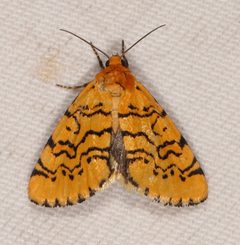
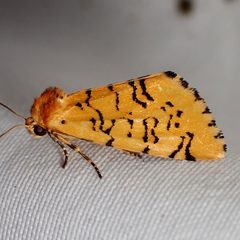
Chrysoecia atrolinea is a of owlet moth in the Noctuidae, Stiriinae. It was described by William Barnes and James Halliday McDunnough in 1912. The species is notable for its bright orange coloration, which is atypical among noctuids. It occurs in southwestern North America, where it has been documented in riparian and mixed conifer forest .
Pronunciation
How to pronounce Chrysoecia atrolinea: //ˌkɹɪsoʊˈiːʃə ˌætroʊˈlɪniə//
These audio files are automatically generated. While they are not always 100% accurate, they are a good starting point.
Images
Habitat
Observed in riparian zones with cottonwood and box elder, and in dry mixed conifer forest with oaks at elevations around 7,000 feet.
Distribution
North America; documented in New Mexico (Grant County, Mimbres River Preserve area) and southwestern United States.
Seasonality
have been observed in late August.
Similar Taxa
- Other Chrysoecia speciesSame , likely similar orange coloration; specific distinguishing features not documented in available sources.
- Other Stiriinae subfamily membersShare characteristics but typically lack the bright orange coloration of C. atrolinea.