
Xylena brucei
(Smith, 1892)
Bruce's Swordgrass Moth
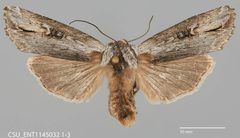
Xylena brucei, commonly known as Bruce's Swordgrass Moth, is a of cutworm moth in the Noctuidae. It was described by Smith in 1892 and is found in North America. The species is assigned Hodges number 9877 in the North American Photographers Group (MPG) system. Like other members of the Xylena, it likely exhibits the characteristic swordgrass moth and patterns.
Pronunciation
How to pronounce Xylena brucei: //zaɪˈliːnə ˈbruːsi.aɪ//
These audio files are automatically generated. While they are not always 100% accurate, they are a good starting point.
Identification
The can be distinguished by its Hodges number 9877 in North American identification systems. As a member of Xylena, it shares the general swordgrass moth , though specific diagnostic features separating it from such as Xylena curvimacula and Xylena nupera require examination of genitalia or wing pattern details not documented in available sources.
Images
Distribution
North America. Specific range details beyond continental presence are not documented in available sources.
Human Relevance
The has minor significance in entomological documentation through its inclusion in the North American Photographers Group database with Hodges number 9877, facilitating standardized identification and recording by lepidopterists.
Similar Taxa
- Xylena curvimaculaCongeneric swordgrass moth with overlapping North American distribution; requires detailed morphological examination to distinguish
- Xylena nuperaCongeneric with similar general appearance; identification relies on subtle wing pattern or genitalic differences
More Details
Nomenclatural history
Originally described as Calocampa brucei by Smith in 1892, later transferred to Xylena
Taxonomic status
Listed as 'synonym' in Catalogue of Life but as 'accepted' in GBIF and NCBI; this discrepancy suggests ongoing taxonomic evaluation or database synchronization issues