
Eucirroedia pampina
(Guenée, 1852)
Scalloped Sallow
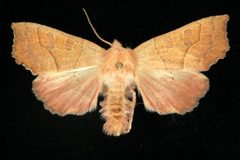
Eucirroedia pampina, commonly known as the scalloped sallow, is a in the Noctuidae. It is widely distributed across eastern and central North America, with active from late summer through early winter. The is recognized by its distinctive scalloped wing margins and moderate size. Larvae are known to feed on the leaves of several hardwood tree species.


Pronunciation
How to pronounce Eucirroedia pampina: /juːˌsɪroʊˈiːdiə ˈpæmpɪnə/
These audio files are automatically generated. While they are not always 100% accurate, they are a good starting point.
Identification
The scalloped sallow can be distinguished from similar noctuid by its prominently scalloped wing margins, which give the its . The combination of yellowish-orange forewings with darker markings and pale hindwings, along with the moderate wingspan of 36–44 mm, helps separate it from related Xylenini moths. The late-season period (August–December) also aids identification.
Images
Appearance
A medium-sized noctuid with a wingspan of 36–44 mm. The forewings are typically yellowish to orange-brown with darker markings and distinctly scalloped outer margins. The hindwings are paler, often yellowish or cream-colored. The body is robust and densely scaled. The scalloped wing edges are a key visual characteristic of this .
Habitat
Deciduous forests and woodlands where trees are present. The is associated with areas containing black cherry, choke cherry, and maple. are attracted to light and can be found in both rural and suburban settings with appropriate tree cover.
Distribution
North America, from British Columbia to Nova Scotia, south to Florida, west to Arkansas and Wisconsin. Records also exist from Alberta, Manitoba, and Saskatchewan in Canada.
Seasonality
are on wing from August to December, with peak activity in September and October. This late-season period is characteristic of the .
Diet
Larvae feed on the leaves of black cherry (Prunus serotina), choke cherry (Prunus virginiana), and maple (Acer ). feeding habits are not documented.
Host Associations
- Prunus serotina - larval black cherry
- Prunus virginiana - larval choke cherry
- Acer - larval maple
Life Cycle
Complete with , larva, pupa, and stages. Larvae are present during the growing season, feeding on tree leaves. Adults emerge in late summer and are active through early winter, with the likely in the egg or pupal stage.
Behavior
are and attracted to light sources. They are active during cooler months when many other have ceased flying.
Ecological Role
Larvae function as herbivores on deciduous trees, contributing to nutrient cycling in forest . The serves as prey for including bats and birds.
Human Relevance
Occasional minor defoliator of ornamental and forest trees. are frequently encountered by enthusiasts at light traps during fall blacklighting sessions.
Similar Taxa
- Other Xylenini mothsSimilar size and coloration, but distinguished by scalloped wing margins and late-season period
- Eucirroedia pampina glenwoodi restricted to Colorado, differs in geographic range and subtle morphological features
More Details
Subspecies
Two are recognized: Eucirroedia pampina pampina (widespread eastern and central North America) and Eucirroedia pampina glenwoodi (Colorado)
Taxonomic history
Originally described as Cirroedia pampina by Guenée in 1852, later transferred to Eucirroedia