
Properigea albimacula
Barnes & McDunnough, 1912
White-spotted Properigea Moth
Properigea albimacula is a small noctuid with a wingspan of approximately 15 mm. It is to the western United States, ranging from southwestern Oregon through California. are active during summer months, with peak abundance in July. The is and readily attracted to artificial light sources.
Pronunciation
How to pronounce Properigea albimacula: //ˌprɒpəˈrɪdʒiə ˌælbɪˈmækjʊlə//
These audio files are automatically generated. While they are not always 100% accurate, they are a good starting point.
Identification
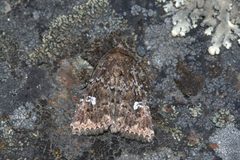
Recognized by small size, warm brown forewing coloration, and pure white-filled spot. Distinguished from Properigea perolivalis, which is grayer in color and occurs in northern California and possibly southwestern Oregon. The combination of warm brown ground color and white reniform spot makes confusion with other regional unlikely.
Images
Habitat
Mixed hardwood forests, oak woodlands, and coastal rainforests west of the Cascades at low to middle elevations. Mixed hardwood-conifer forests on the west slope of the Cascades at higher elevations. Dry forests and riparian areas east of the Cascades.
Distribution
Western United States: slopes of the Cascades north of Oregon (southwestern Oregon), and almost throughout California.
Seasonality
fly during summer, most common in July. activity pattern.
Behavior
. come to lights.
Human Relevance
Attracted to artificial lights; occasionally encountered by observers using light traps.
Similar Taxa
- Properigea perolivalisSimilar size and ; distinguished by grayer coloration versus warm brown in P. albimacula. Range overlap in northern California and possibly southwestern Oregon.
More Details
Original description
First described by William Barnes and James Halliday McDunnough in 1912.
Taxonomic history
Originally described under the basionym Namangana albimacula.