
Ipimorpha pleonectusa
Grote, 1873
Even-lined Sallow, Blackcheeked Aspen Caterpillar
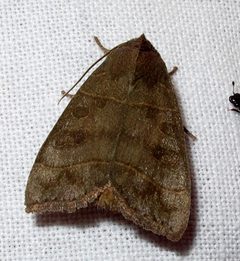
Ipimorpha pleonectusa, the Even-lined Sallow, is a noctuid native to North America. It is one of two recognized in the Ipimorpha on the continent. The species was described by Augustus Radcliffe Grote in 1873. are and attracted to light. The 'blackcheeked aspen caterpillar' refers to the larval stage, though specific plant associations require verification.
Pronunciation
How to pronounce Ipimorpha pleonectusa: /ˌɪpɪˈmɔrfə ˌpliːoʊˈnɛksə/
These audio files are automatically generated. While they are not always 100% accurate, they are a good starting point.
Identification
are distinguished from similar noctuids by the evenly spaced, straight longitudinal lines on the forewings. The Ipimorpha contains only two North American ; I. pleonectusa can be separated from I. retusa (the lesser broad-bordered yellow underwing) by wing pattern and, where known, geographic range. Specimen examination or genitalia dissection may be required for definitive identification. The Hodges number 9555 is used in North American classification systems.
Images
Habitat
Associated with forested environments, particularly where aspen (Populus spp.) occurs, based on the larval . Specific preferences for are poorly documented but likely include woodland edges and mixed forests.
Distribution
Recorded across North America with confirmed presence in Canada (Alberta, Manitoba, Saskatchewan) and the United States (Vermont). The full range likely extends more broadly across northern and eastern North America, though precise limits are not well established.
Seasonality
period spans late spring through summer, with most observations concentrated in June through August. Specific varies by latitude.
Host Associations
- Populus - larval Implied by 'blackcheeked aspen caterpillar'; direct documentation of feeding records is not confirmed in provided sources
Life Cycle
Complete with , larva, pupa, and stages. Larvae are presumably present in summer and fall, as pupae or larvae depending on latitude—specific details are not documented in available sources.
Behavior
are and attracted to light sources. Otherwise, specific behavioral traits are not well documented.
Ecological Role
Larvae likely function as herbivores on woody plants, potentially contributing to nutrient cycling in forest . may serve as prey for .
Human Relevance
No significant economic or agricultural impact has been documented. Occasionally encountered by enthusiasts and documented through citizen science platforms such as iNaturalist. The Hodges number 9555 facilitates communication among North American lepidopterists.
Similar Taxa
- Ipimorpha retusaThe only other North American in the ; differs in forewing pattern with more irregular or broader lines, and has different geographic tendencies
- Xylena spp.Similar noctuid with longitudinal forewing lines; Xylena often show more contrasting pattern elements and different periods
- Lithophane spp.Noctuids with somewhat similar plain brown forewings; Lithophane typically have more rounded wing apices and different underwing patterns
More Details
Taxonomic History
Described by Augustus Radcliffe Grote in 1873, a prominent 19th-century American lepidopterist. The specific epithet 'pleonectusa' derives from Greek roots suggesting 'more inclined' or 'having more,' though the precise etymological intent is not documented.
Nomenclature
The Hodges number 9555 refers to the systematic numbering in 'Check List of the Lepidoptera of America North of Mexico' (1983), edited by Ronald B. Hodges.
Observation Data
As of source date, iNaturalist over 1,100 research-grade observations, indicating this is a moderately well-documented through citizen science, though concentrated in regions with active naturalist .