
Fishia nigrescens
Hammond & Crabo, 2013
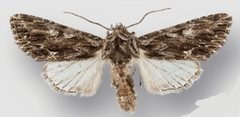
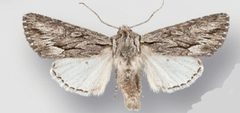
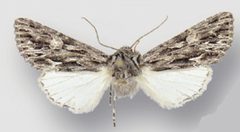
Fishia nigrescens is a noctuid described in 2013, found in arid regions of the western United States. are active in late fall, primarily October. The species name refers to the dark, charcoal gray forewing coloration. Larvae have been documented feeding on Ericameria nauseosa, a shrub in the sunflower .
Pronunciation
How to pronounce Fishia nigrescens: /ˈfiːʃiə nɪˈɡrɛsɛnz/
These audio files are automatically generated. While they are not always 100% accurate, they are a good starting point.
Identification
Distinguished from related noctuids by the combination of slightly mottled charcoal gray forewings, small size (18–20 mm forewing length), and the incomplete gray medial line on hindwings with scattered basal gray . The late fall period (October) may help separate it from sympatric with different .
Images
Appearance
Males have forewings 19–20 mm in length; females 18 mm. Forewings of both sexes are slightly mottled charcoal gray. Hindwings light gray in females, with an incomplete gray medial line and scattered gray in the basal row present in both sexes.
Habitat
Sage steppe and open juniper forests in arid western North America.
Distribution
Central and eastern Oregon, Nevada, eastern California, and Arizona.
Seasonality
are on wing in late fall, usually during October.
Diet
Larvae feed on Ericameria nauseosa (rabbitbrush, Asteraceae).
Host Associations
- Ericameria nauseosa - larval Confirmed through rearing records; larvae collected in May, pupated in June, and emerged late September of same year
Life Cycle
Complete . Larvae collected in May, pupated in June, and emerged late September. Larvae described as green with a white lateral band.
More Details
Etymology
The name is derived from Latin niger (meaning black or dusky), referring to the forewing coloration.
Taxonomic history
Described by Hammond & Crabo in 2013.
Sources and further reading
- BugGuide
- Wikipedia
- GBIF taxonomy match
- iNaturalist taxon
- Encyrtid Holdings | Entomology Research Museum
- Alydidae | Beetles In The Bush
- Nomenclatural changes in Phymatodes | Beetles In The Bush
- Working with Cerceris fumipennis—Epilogue | Beetles In The Bush
- Bug Eric: Flying Ants
- 9th Annual Fall Tiger Beetle Trip: Day 1 | Beetles In The Bush