
Morrisonia latex
(Guenée, 1852)
Fluid Arches
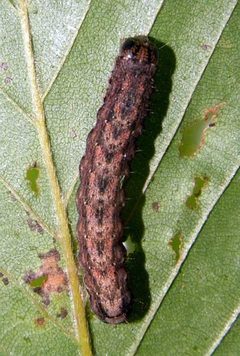
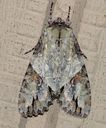
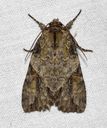
A noctuid native to eastern and central North America, commonly known as the Fluid Arches. are active in late spring and early summer. The was first described by Achille Guenée in 1852. Larvae are on deciduous trees and shrubs, with documented feeding on maples, birches, oaks, and other woody plants.
Pronunciation
How to pronounce Morrisonia latex: //mɔːˈrɪs.i.oʊ.ni.ə ˈlæ.tɛks//
These audio files are automatically generated. While they are not always 100% accurate, they are a good starting point.
Identification
The "Fluid Arches" likely refers to wing pattern characteristics, though specific diagnostic features are not well documented in available sources. As a member of the Morrisonia, it belongs to a group of noctuid that often exhibit relatively plain forewings with subtle pattern elements. Accurate identification likely requires examination of genitalia or reference to regional moth identification guides.
Images
Habitat
Associated with deciduous forest where larval plants occur. Found in regions supporting mixed hardwood forests.
Distribution
Eastern and central North America. Range extends from Nova Scotia south to South Carolina, west to Arkansas, and north to Manitoba.
Seasonality
fly from May to July, with timing varying by location.
Diet
Larvae feed on leaves of multiple deciduous tree and shrub . Documented include: Acer rubrum, Acer saccharum, Acer saccharinum, Acer nigrum (maples); Prunus serotina (black cherry); Betula lenta, Betula nigra, Betula lutea, Betula papyrifera (birches); Ulmus americana (American elm); Nyssa sylvatica (black tupelo); Quercus alba, Quercus rubra, Quercus prinus, Quercus velutina (oaks); and Sassafras albidum (sassafras).
Ecological Role
Larval stage functions as a herbivore in deciduous forest , consuming leaves of common and understory tree .
Sources and further reading
- BugGuide
- Wikipedia
- GBIF taxonomy match
- iNaturalist taxon
- NCBI Taxonomy
- Bugs in orange and black III, Halloween edition: Milkweed longhorned beetles, Tetraopes sp. — Bug of the Week
- Bane of dogbane, the beautiful and the ugly: Dogbane leaf beetle, Chrysochus auaratus, and dogbane webworm, Saucrobotys futilalis — Bug of the Week
- Hooray for the red, white, and blue! Milkweed longhorned beetle, Tetraopes tetraophthalmus; dogbane tiger moth, Cycnia tenera; and familiar bluet, Enallagma civile — Bug of the Week
- Hairy milkweed beetle | Beetles In The Bush
- Rush skeletonplant pea gall wasp | Beetles In The Bush
- When Art Meets Science: A Rice-Paper Rubbing Technique for Measuring Bark Beetle Damage