
Graphiphora augur
(Fabricius, 1775)
double dart, soothsayer, soothsayer dart
Graphiphora augur is a Noctuidae commonly known as the double dart or soothsayer. The has a Holarctic distribution, occurring across northern North America from Canada to California and New Mexico, and throughout Eurasia from the British Isles to Japan. fly in summer with a single per year. Larvae feed on a range of woody plants including willows, birches, poplars, and roses.

Pronunciation
How to pronounce Graphiphora augur: //ˌɡræfɪˈfɔːrə ˈɔːɡər//
These audio files are automatically generated. While they are not always 100% accurate, they are a good starting point.
Identification
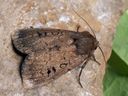
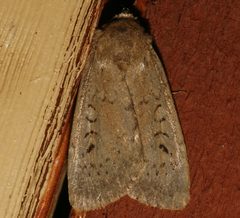
Distinguished from similar noctuid by the combination of uniform brownish-grey forewings with reddish tinge and the distinctive stigma with swollen outer edge. The variable stigma—round, flattened, or elongated to touch the inner line—provides additional diagnostic characters. Form hippophaes lacks the reddish tinge; form helvetina is pale and blurred with obscure markings and pink hindwing fringe.
Images
Distribution
Holarctic. North America: all of Canada, northern United States, south in the west to California and New Mexico. Eurasia: British Isles, Scandinavia, across Europe to Siberia and Japan.
Seasonality
on wing June to August depending on location. Single per year.
Diet
Larvae feed on various trees and shrubs: Betula (birch), Salix caprea, Salix phylicifolia, Salix cinerea (willows), Populus tremula, Populus balsamifera (poplars), Ribes, Rosa (including Rosa acicularis), Syringa vulgaris, and Lonicera caerulea.
Life Cycle
One per year. Larvae described as varying from purplish brown to greenish grey with double row of whitish spots on dorsum, oblique dark streaks, and dark brown blotch across segment 12 that is swollen at each end and edged behind with pale.
Similar Taxa
- Other NoctuinaeG. augur distinguished by reddish-tinged forewings and distinctive stigma shapes, particularly the swollen outer edge of the stigma