
Diarsia esurialis
Grote, 1881
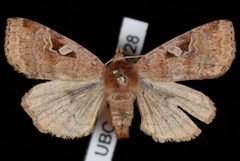
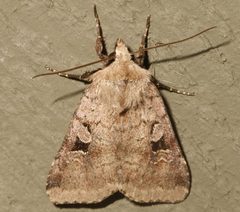
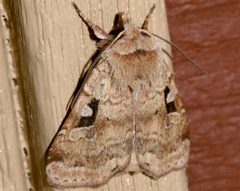
Diarsia esurialis is a noctuid native to the Pacific coast of North America. It is abundant in wet coastal forests from Alaska through California. fly in midsummer and have a wingspan of approximately 33 mm. The larvae feed on foliage of Corylus (hazelnut) and Alnus (alder).
Pronunciation
How to pronounce Diarsia esurialis: /diˈarsia esuˈrialis/
These audio files are automatically generated. While they are not always 100% accurate, they are a good starting point.
Identification
The can be distinguished from other Diarsia by its Pacific coastal distribution and association with wet forest . Specific diagnostic features separating it from such as D. rubifera or D. dislocata are not documented in the provided sources. Genitalia examination may be required for definitive identification.
Images
Appearance
have a wingspan of approximately 33 mm. As a member of the Diarsia, it likely exhibits the characteristic dull brown to reddish-brown forewing coloration with variable darker markings typical of the group, though specific pattern details for this are not well documented in the provided sources.
Habitat
Abundant in wet coastal forests. Associated with forested environments containing larval plants Corylus and Alnus.
Distribution
Pacific coast of North America: Alaska, British Columbia, Washington, Oregon, and California.
Seasonality
are on wing in midsummer.
Diet
Larvae feed on the foliage of Corylus (hazelnut) and Alnus (alder). feeding habits are not documented.
Host Associations
- Corylus - larval foliage
- Alnus - larval foliage
Life Cycle
Complete with , larval, pupal, and stages. Specific timing of stages is not documented. Adults emerge in midsummer.
Ecological Role
Larval herbivore on deciduous woody plants in coastal forest . Specific ecological functions beyond herbivory are not documented.
Similar Taxa
- Diarsia rubiferaOverlapping range and similar appearance; may require genitalia examination for separation.
- Diarsia dislocataSympatric in western North America; similar dull brown coloration.