
Feltia subterranea
Fabricius, 1794
granulate cutworm, subterranean dart moth, tawny shoulder, Subterranean Dart
Feltia subterranea is a noctuid whose larvae are subterranean cutworms feeding on plant roots and crowns. The has a broad geographic range spanning North, Central, and South America, as well as Hawaii. have a wingspan of 38–44 mm and are known to pollinate fetterbush lyonia. The larvae are pests of numerous agricultural crops.
Pronunciation
How to pronounce Feltia subterranea: //ˈfɛl.ti.ə ˌsʌb.təˈreɪ.ni.ə//
These audio files are automatically generated. While they are not always 100% accurate, they are a good starting point.
Images
Appearance
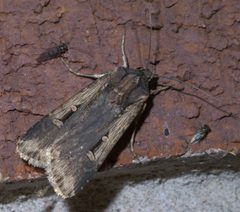
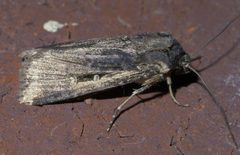
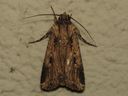
have a wingspan of 38–44 mm. The forewings are typically brownish-gray with variable patterning. The "tawny shoulder" refers to a distinctive tawny or yellowish-brown patch on the shoulder region of the forewing. The hindwings are paler, usually grayish or whitish. Body coloration varies but is generally dull brown to gray, providing camouflage against soil and debris.
Distribution
Native to and widely distributed across the Americas. In North America, recorded from Massachusetts and New York west to California, throughout the southern United States, and into Mexico. Present in Central America (Honduras, Rica, Panama, Cuba) and South America (Venezuela, Colombia, southeastern Brazil, Uruguay, Chile, the Antilles). Also established in Hawaii.
Diet
Larvae feed on a wide range of plants, including over 61 of economic importance. Specific host plants include agricultural crops; the broad host range contributes to its pest status. feed on nectar and have been observed pollinating fetterbush lyonia.
Host Associations
- fetterbush lyonia - pollinated by
Life Cycle
Complete with , larva, pupa, and stages. Larvae are subterranean "cutworms" that feed below ground on roots and plant crowns. Eggs are laid in or on plants; emerging larvae migrate to the soil to complete development. occurs underground.
Behavior
Larvae exhibit subterranean feeding , cutting off plants at or below the soil surface. are and visit flowers for nectar. Females of the ichneumon Ceratogastra ornata have been observed ovipositing into or early instars of Feltia larvae in flower buds, particularly on ragweed (Ambrosia artemisiifolia) and thoroughworts (Eupatorium).
Ecological Role
Larvae function as herbivores and agricultural pests due to their root-feeding damage. serve as for at least one documented plant . The species is a known for , including Ceratogastra ornata, which may provide natural .
Human Relevance
Larvae are significant agricultural pests causing damage to over 61 economically important crop by feeding on roots and crowns. The subterranean habit makes larvae difficult to detect and control. Formerly placed in Agrotis, a group notorious for damage.
Similar Taxa
- Agrotis spp.Formerly classified in this ; similar subterranean larvae and require genitalic examination or molecular methods for definitive separation. Many Agrotis share the "cutworm" and similar ecological habits.
Sources and further reading
- BugGuide
- Wikipedia
- GBIF taxonomy match
- iNaturalist taxon
- Bug Eric: Ichneumon Wasp: Ceratogastra ornata
- How art can amplify subterranean science
- New Management Methods Emerge for Walnut Husk Fly
- Balancing Eradication and Management: The Role of Biocontrol in Asian Longhorned Beetle Defense
- How a City-Raised Entomologist Found Her Path in Agricultural Pest Management
- New Guide Offers Latest in Carrot Weevil Management