
Homorthodes perturba
McDunnough, 1943
cutworm, dart moth
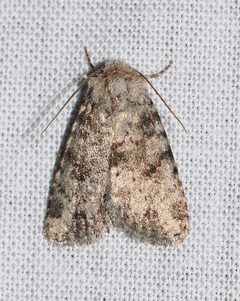
Homorthodes perturba is a of noctuid first described by James Halliday McDunnough in 1943. It belongs to the or dart moth group within the Noctuidae, a large and diverse family of moths commonly known as owlet moths. The species is documented from North America, though specific details about its and remain limited in available sources.
Pronunciation
How to pronounce Homorthodes perturba: //hɔːˈmɔːr.θəˌdiːz pərˈtɜːr.bə//
These audio files are automatically generated. While they are not always 100% accurate, they are a good starting point.
Identification
The MONA or Hodges number for this is 10544, which serves as a standardized identifier in North American classification systems. As a member of the Homorthodes, it can be distinguished from related genera within the Eriopygini tribe by genitalic characteristics and wing pattern elements, though specific diagnostic features for H. perturba versus require examination.
Images
Distribution
North America. Specific range details beyond this continental designation are not documented in available sources.
Similar Taxa
- Other Homorthodes species within the Homorthodes share similar overall and require careful examination of genitalia and wing venation patterns for definitive identification.
- Other Eriopygini tribe membersTribe-level similarities in forewing pattern and body form necessitate detailed morphological analysis to distinguish from related .
More Details
Taxonomic authority
Described by Canadian entomologist James Halliday McDunnough (1877-1962), a prominent figure in North American lepidopterology who authored numerous descriptions and contributed significantly to classification.
Nomenclature
The specific epithet 'perturba' is Latin, potentially alluding to disturbed or disrupted pattern elements, though the original description should be consulted for the author's intended etymology.
Sources and further reading
- BugGuide
- Wikipedia
- GBIF taxonomy match
- iNaturalist taxon
- NCBI Taxonomy
- Catalogue of Life
- Forget the Soaps: Let's Talk Soapberry Bugs! | Bug Squad
- Spotlight on UC Davis Professor Louie Yang and Monarch Research | Bug Squad
- Why Smoking Soothes the Stressed-Out Bee Hive
- Assessments of alien species impacts are reliable to prioritize resources | Blog
- Crazy, snaky worms in your garden? Could be jumping worms, Amynthas spp. — Bug of the Week