
Amphipoea
Billberg, 1820
Ear Moths
Species Guides
7- Amphipoea americana(American ear moth)
- Amphipoea erepta(cutworm)
- Amphipoea interoceanica(Interoceanic Ear Moth)
- Amphipoea keiferi(Northwestern Iris Borer Moth)
- Amphipoea lunata
- Amphipoea pacifica(Pacific Ear Moth)
- Amphipoea senilis(Southwestern Ear Moth)
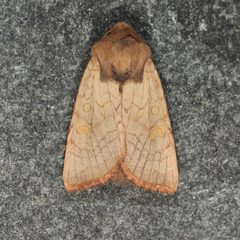
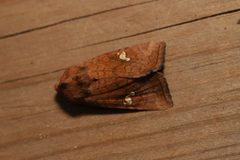
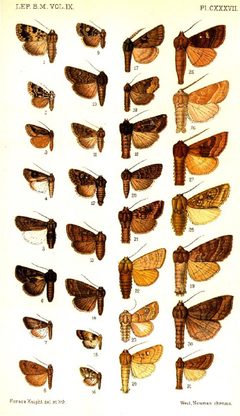
A of medium-sized noctuid found in the . are notoriously difficult to distinguish from one another based on external alone, with identification often requiring examination of genitalia or . The genus name derives from Greek roots referring to 'round grass,' alluding to the grassy these moths occupy.
Pronunciation
How to pronounce Amphipoea: //ˌæmfiˈpiːə//
These audio files are automatically generated. While they are not always 100% accurate, they are a good starting point.
Identification
External features are insufficient for reliable identification within this . Male genitalia show diagnostic differences in clasper arm structure; in A. lucens, the longer arm is usually curved distally. Female genitalia also differ between species. Forewings typically display orange and stigmata with strong bands on the underside, but these traits overlap across .
Images
Habitat
Associated with damp grassy environments, particularly acid moorland and marshes. The name itself references this grassland .
Distribution
Holarctic distribution spanning the western Palaearctic from southern Scandinavia to Italy, with scattered records eastward to northern Japan and Korea. Present in North America including Vermont. In Europe, northern are more prevalent; UK records show northern concentration extending to the Shetlands.
Seasonality
Monovoltine fly from late July to early October in the UK.
Diet
Larval feeding documented on purple moor grass (Molinia caerulea) and common cottongrass (Eriophorum angustifolium). visit flowers of rushes and heathers.
Host Associations
- Molinia caerulea - larval food plantpurple moor grass
- Eriophorum angustifolium - larval food plantcommon cottongrass
Life Cycle
Overwinters as an . Single per year.
Behavior
are flower visitors. within this are morphologically cryptic, with external appearance providing poor discrimination between . shows clustering patterns with some exemplar identification confusion between species.
Human Relevance
of A. lucens has been sequenced, providing a 647.7 Mb assembly from a Scottish specimen. UK of A. lucens appear to have declined since 1970.
Similar Taxa
- Loscopia velataFormerly classified as Amphipoea velata; reclassified to Loscopia
- Other Amphipoea congenersExternal overlaps extensively; reliable separation requires genital dissection or molecular methods