
Pyrrhia aurantiago
Guenée, 1852
Orange Sallow, Aureolaria Seed Borer
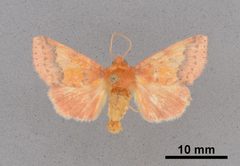
Pyrrhia aurantiago, commonly known as the Orange Sallow or Aureolaria Seed Borer, is a noctuid native to eastern North America. The has a scattered distribution from New England west to Wisconsin and Missouri, extending south to Florida and Texas. It is listed as threatened in Connecticut. The "Aureolaria Seed Borer" reflects its documented association with Aureolaria (false foxglove) plants.
Pronunciation
How to pronounce Pyrrhia aurantiago: /ˈpɪriə ɔːˌriːənˈtaɪɡoʊ/
These audio files are automatically generated. While they are not always 100% accurate, they are a good starting point.
Identification
Orange forewing coloration separates this from in the Pyrrhia, most of which exhibit duller brown, gray, or ochre tones. The scattered eastern North American distribution and association with Aureolaria plants provide additional context for identification. Genitalia examination may be required for definitive identification from similar orange-colored noctuids.
Images
Habitat
Associated with Aureolaria (false foxglove) plants, suggesting open woodlands, forest edges, and prairie-savanna transitions where these hemiparasitic plants occur. The scattered distribution pattern implies specific requirements rather than broad ecological .
Distribution
Eastern North America: southern Maine, hills around Boston (Massachusetts), west across southern Ontario to south-western Wisconsin and Missouri, south to Florida and Texas. Distribution is notably scattered and discontinuous rather than continuous across this range.
Diet
Larvae bore into seeds of Aureolaria (false foxgloves, Orobanchaceae). feeding habits not documented.
Host Associations
- Aureolaria - larval of hemiparasitic plants in Orobanchaceae; "Aureolaria Seed Borer" directly references this association
Behavior
Larval : seed boring within Aureolaria fruits. behavior patterns not documented in available sources.
Ecological Role
As a seed of Aureolaria, likely influences plant and seed in where both co-occur. Specific ecological impacts not quantified.
Human Relevance
Listed as threatened in Connecticut, indicating conservation concern in parts of its range. No documented economic or agricultural significance. "Aureolaria Seed Borer" used in seed identification contexts.
Similar Taxa
- Other Pyrrhia species Pyrrhia contains multiple with similar size and wing shape; P. aurantiago distinguished by orange coloration versus brown/gray tones in
More Details
Taxonomic Note
The has been treated under the synonym Rhodoecia aurantiago in some literature. The current accepted combination is Pyrrhia aurantiago Guenée, 1852.
Conservation Status
State-level protection in Connecticut suggests vulnerability, possibly due to loss affecting Aureolaria plants.