
Heliocheilus paradoxus
Grote, 1865
Paradoxical Grass Moth
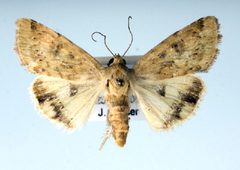
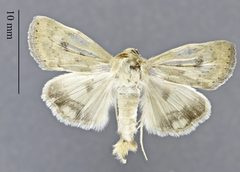
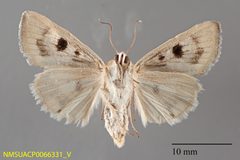
Heliocheilus paradoxus, commonly known as the paradoxical , is a of noctuid described by Augustus Radcliffe Grote in 1865. It belongs to the Heliothinae within the Noctuidae. The species has been documented across a broad North American range spanning southern Canada to the southern United States.
Pronunciation
How to pronounce Heliocheilus paradoxus: /ˌhɛl.i.oʊˈkaɪ.ləs ˌpær.əˈdɒk.səs/
These audio files are automatically generated. While they are not always 100% accurate, they are a good starting point.
Identification
The can be distinguished from related Heliocheilus species by a combination of genitalic and forewing pattern characteristics, though specific diagnostic features require reference to original taxonomic descriptions. The 'paradoxical' likely refers to unusual or unexpected morphological features noted by Grote during original description.
Images
Appearance
have a wingspan of 24–26 mm. Specific details of wing pattern, coloration, and body beyond wingspan measurements are not documented in available sources.
Distribution
Documented from Ontario and British Columbia in Canada, southward through the United States to at least California, Arizona, Texas, and Florida. The occupies a broad latitudinal range across North America.
Similar Taxa
- Other Heliocheilus speciesMembers of the Heliocheilus share similar general and preferences in grassland and open habitats; precise identification requires examination of genitalic structures and wing pattern details.
More Details
Taxonomic history
Described by Augustus Radcliffe Grote in 1865, a prominent 19th-century American entomologist specializing in Lepidoptera. The specific epithet 'paradoxus' suggests Grote encountered morphological features that appeared contradictory or unexpected relative to related known at that time.
Research status
Despite being described over 150 years ago, detailed biological and ecological information for this remains sparse. Available literature focuses primarily on taxonomic placement and distribution records rather than studies.