
Cryphia
Hübner, 1818
Species Guides
9Cryphia is a of in the Noctuidae, Bryophilinae. Established by Jacob Hübner in 1818, the genus contains approximately 40 distributed across the Palearctic and Nearctic regions. Several species have well-known , including the marbled beauty (C. domestica), marbled green (C. muralis), and tree-lichen beauty (C. ).
Pronunciation
How to pronounce Cryphia: /ˈkrɪ.fi.ə/
These audio files are automatically generated. While they are not always 100% accurate, they are a good starting point.
Identification
Distinguished from related by the combination of upturned slender palpi with the third joint reaching above the vertex, minutely ciliated , and thoracic tufts behind the collar. The is notably longer than the hindwing with slight tufts. -level identification requires examination of genitalia and wing pattern details.
Images
Appearance
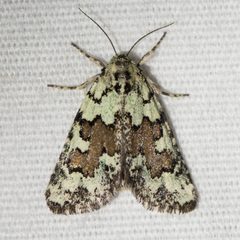
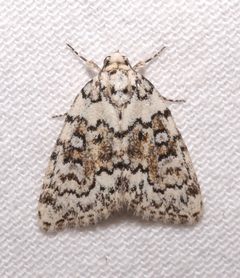
Palpi slender and upturned, with the third joint extending above the vertex of the . minutely ciliated. bears slight tufts behind the collar. has slight tufts and is longer than the hindwing. Larvae possess four pairs of abdominal .
Habitat
in this are typically associated with rocky , walls, and structures where lichens grow. The "marbled beauty" for C. domestica reflects its association with human-built environments. Several species are known to inhabit coastal cliffs, rocky outcrops, and urban settings.
Distribution
Palearctic and Nearctic regions. Individual have more restricted ranges: C. domestica occurs across Europe and has been introduced to North America; C. muralis is widespread in Europe; C. has a broad Palearctic distribution.
Seasonality
are generally active from late spring through autumn, with peak activity varying by . Most species appear to be single-brooded (), though some may have partial second in favorable conditions.
Life Cycle
Larvae have four pairs of abdominal . Specific plant relationships are poorly documented for most , though some are known to feed on lichens.
Behavior
are and attracted to light. Some regularly enter buildings and are found resting on walls during the day.
Human Relevance
Several are familiar to naturalists and enthusiasts due to their distinctive appearance and tendency to occur in human-modified environments. C. domestica (marbled beauty) and C. muralis (marbled green) are regularly recorded in garden moth trapping.
Similar Taxa
- BryophilaFormerly included some Cryphia ; distinguished by differences in male genitalia and wing venation
- BryolymniaFormerly included Cryphia viridata, now Bryolymnia viridata; separated based on genitalic and morphological characters
- BryoleucaRelated bryophiline with similar overall appearance but differing in genitalic structure
More Details
Taxonomic history
The has undergone significant taxonomic revision, with several transferred to related genera such as Bryophila and Bryolymnia. The placement in Bryophilinae reflects modern molecular and morphological studies.
Species diversity
The contains approximately 40 described , with the greatest diversity in the Palearctic region. Several species were described relatively recently, including C. merhaba (2006) and C. flavipuncta (2006).