
Eudryas grata
Fabricius, 1793
Beautiful Wood-nymph
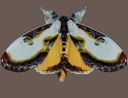
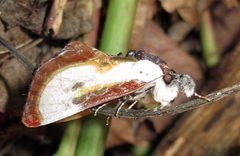
Eudryas grata, commonly known as the beautiful wood-nymph, is a in the Noctuidae. are notable for their remarkable mimicry of bird droppings, a defensive that deters visually-oriented . The species ranges across eastern North America, with caterpillars feeding on several plant species in the grape family (Vitaceae).
Pronunciation
How to pronounce Eudryas grata: /juːˈdraɪəs ˈɡreɪtə/
These audio files are automatically generated. While they are not always 100% accurate, they are a good starting point.
Identification
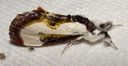
The beautiful wood-nymph is distinguished from similar by its exceptionally convincing bird-dropping mimicry. The pattern of white, brown, and black patches is irregular and lacks the symmetrical wing patterns typical of many moths. When at rest, the wings are held in a posture that enhances the bird-dropping illusion. Similar in the Eudryas, such as Eudryas unio, can be differentiated by subtle differences in wing pattern and geographic distribution.
Images
Habitat
Deciduous forests, woodland edges, and areas with abundant plants including Virginia creeper, grapes, and related vines. The is associated with both natural and semi-urban environments where host plants occur.
Distribution
Eastern North America, ranging from Canada south to Texas. The is found predominantly across the entire eastern United States, with records from Vermont and throughout the region.
Seasonality
In the northern part of its range, one occurs annually. In Florida and southern states, multiple generations occur each year. are active during the warmer months, with timing varying by latitude.
Diet
Caterpillars feed on leaves of Virginia creeper (Parthenocissus quinquefolia), grapes (Vitis ), hops (Humulus), buttonbush (Cephalanthus), and Ampelopsis. feeding habits are not well documented.
Host Associations
- Parthenocissus quinquefolia - larval Virginia creeper
- Vitis - larval grapes
- Humulus - larval hops
- Cephalanthus - larval buttonbush
- Ampelopsis - larval
Life Cycle
Complete with , larva, pupa, and stages. Caterpillars feed on plant foliage before pupating. Number of per year varies geographically: in the north, multivoltine in the south.
Behavior
are and attracted to light. When disturbed, they may remain motionless to maintain the bird-dropping illusion. The has been observed at blacklight setups during surveys.
Ecological Role
Caterpillars function as herbivores on native vines and shrubs. may contribute to pollination, though this has not been quantified. The bird-dropping mimicry represents a notable example of defensive in Lepidoptera.
Human Relevance
The is frequently encountered by citizen scientists during -watching events and blacklight surveys. Its remarkable mimicry makes it a popular subject for nature photography and educational demonstrations of defensive adaptations. The caterpillars occasionally feed on cultivated grapes but are not considered a significant agricultural pest.
Similar Taxa
- Eudryas unioSimilar bird-dropping mimicry and appearance, but differs in wing pattern details and has a more western distribution
- Limenitis arthemis astyanaxRed-spotted purple caterpillars also mimic bird droppings, but belong to a different (Nymphalidae) and feed on different plants
- Papilio polyxenesBlack swallowtail caterpillars mimic bird droppings in early instars, but develop different coloration later and have distinct
More Details
Etymology
The specific epithet "grata" is Latin for "pleasing" or "welcome," perhaps alluding to the ' distinctive appearance.
Sources and further reading
- BugGuide
- Wikipedia
- GBIF taxonomy match
- iNaturalist taxon
- NCBI Taxonomy
- Catalogue of Life
- 11 new species and a new rapid species description platform
- ocean species | Blog
- Bird droppings? Nope, clever moths and caterpillars looking like poop: Beautiful wood-nymph, Eastern tiger swallowtail, Black swallowtail, Red-spotted purple — Bug of the Week
- Bug Eric: National Moth Week 2021 Review
- Bug Eric: Last Night to Blacklight?
- Bug Eric: National Moth Week 2024 Recap from Kansas City