
Anomis flava
(Fabricius, 1775)
cotton looper, tropical anomis, white-pupiled scallop moth
Anomis flava is a widespread in the Erebidae, first described by Fabricius in 1775. It is known by multiple reflecting its agricultural significance (cotton looper), geographic range (tropical anomis), and distinctive (white-pupiled scallop moth). The species has a broad distribution spanning tropical and subtropical regions across Asia, Africa, Australasia, Pacific Islands, and North America (as the A. flava fimbriago). It is primarily recognized as a pest of cotton and other malvaceous plants.
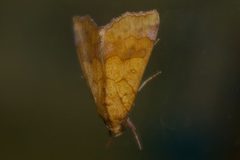
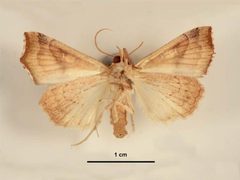
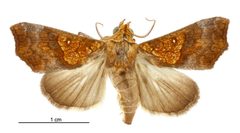
Pronunciation
How to pronounce Anomis flava: /ˈæn.əˌmɪs ˈfleɪ.və/
These audio files are automatically generated. While they are not always 100% accurate, they are a good starting point.
Images
Habitat
Cotton agroecosystems; also associated with other cultivated and wild plants including Hibiscus . Larval distribution on cotton plants shows a distinct pattern centered on middle-aged leaves (14–21 days old) located centrally on both horizontal and vertical axes of the plant.
Distribution
Asia (China, Thailand, Burma, Cambodia, Hong Kong, India, Indonesia, Japan, Korea, South Laos, Malaysia, Pakistan, Philippines, Sikkim, Sri Lanka, Taiwan, Vietnam); Africa (Angola, Benin, Cameroon, Chad, Ethiopia, Gambia, Ghana, Ivory Coast, Kenya, Madagascar, Malawi, Mali, Mauritius, Niger, Nigeria, Rhodesia, Senegal, Somalia, Sudan, Tanzania, Togo, Uganda, Upper Volta, Zaire, Zambia); Australasia and Pacific Islands (Australia including New South Wales, Norfolk Island, Northern Territory, Queensland, Western Australia; Cook Islands, Fiji, Marianas Islands, Marquesas Islands, New Caledonia, New Hebrides, Papua New Guinea, Samoa, Society Islands, Solomon Islands, Tonga, Irian Jaya); Hawaii; São Tomé and Príncipe. A. flava fimbriago occurs in North America.
Diet
Larvae feed on leaves of Gossypium hirsutum (cotton), Hibiscus rosa-sinensis, Hibiscus cannabinus, and Legnephora moorei.
Host Associations
- Gossypium hirsutum - larval food plantprimary ; major agricultural pest
- Hibiscus rosa-sinensis - larval food plant
- Hibiscus cannabinus - larval food plant
- Legnephora moorei - larval food plant
- Abutilon - larval food plantfrom distribution map source
- Solanum lycopersicum - larval food planttomato; from distribution map source
- Abelmoschus esculentus - larval food plantokra; from distribution map source
Behavior
Larvae exhibit a characteristic looping movement pattern (hence "looper" and "semi-looper" ). Larval distribution on plants develops a distinct spatial pattern with highest and damage concentrated on leaves of intermediate age. can be substantially modified by nucleopolyhedrosis virus .
Ecological Role
Agricultural pest affecting photosynthetic capacity of cotton by feeding on leaves during their peak functional period. The is incorporated into programs for cotton in some regions.
Human Relevance
Significant agricultural pest of cotton and related malvaceous crops. Subject of pest management research and monitoring in cotton-growing regions of Australia and elsewhere.
Sources and further reading
- BugGuide
- Wikipedia
- GBIF taxonomy match
- iNaturalist taxon
- NCBI Taxonomy
- Catalogue of Life
- Diet Detoxification in Insects | Bug Squad
- Lewis Ocean Bay Heritage Preserve & Wildlife Management Area | Beetles In The Bush
- Revision of the Formicidae of North America | Beetles In The Bush
- Anomis flava . [Distribution map].
- Biology of the Cotton Semi-Looper, Anomis flava flava (Fabr.) (Noctuidae, Lepidoptera)
- The distribution of cotton looper ( Anomis flava Fabr.) larvae and larval damage on cotton and its relationship to the photosynthetic potential of cotton leaves at the attack sites