
Anomis erosa
Hübner, 1818
Yellow Scallop Moth, Abutilon Moth
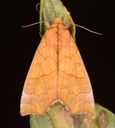
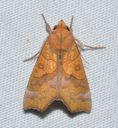
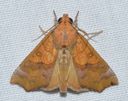
Anomis erosa is a small in the Erebidae, commonly known as the yellow scallop moth or abutilon moth. First described by Jacob Hübner in 1818, it occurs primarily in southeastern North America, with migrants occasionally reaching as far north as Manitoba, Quebec, and Maine. The has a wingspan of approximately 27 mm. Larvae are specialized feeders on plants in the family Malvaceae, including cotton, hibiscus, and okra.
Pronunciation
How to pronounce Anomis erosa: /ˈæn.oʊ.mɪs ɪˈroʊ.sə/
These audio files are automatically generated. While they are not always 100% accurate, they are a good starting point.
Identification
The yellow scallop can be distinguished by its small size (wingspan ~27 mm) and the scalloped or wavy patterning on the wing margins that gives the its . The yellow coloration serves as the primary visual cue for identification. Similar species in the Anomis may require examination of genitalia or detailed wing pattern analysis for definitive separation.
Images
Habitat
Found in open and disturbed where plants in the Malvaceae occur, including agricultural fields, gardens, and natural areas with native mallows.
Distribution
Southeastern North America, primarily a southern . Core range extends through the southeastern United States. Migrants have been recorded reaching Manitoba, Quebec, and Maine in the north. Also present in France based on distribution records.
Diet
Larvae feed exclusively on plants in the Malvaceae, including cotton (Gossypium), Hibiscus, rose of Sharon (Hibiscus syriacus), hollyhock (Alcea), marsh mallow (Althaea), okra (Abelmoschus), rose-mallow (Hibiscus moscheutos), velvet leaf (Abutilon), and other Malvaceae . feeding habits are not documented.
Host Associations
- Gossypium - larval food plantcotton
- Hibiscus - larval food plantincludes rose of Sharon and rose-mallow
- Alcea - larval food planthollyhock
- Althaea - larval food plantmarsh mallow
- Abelmoschus - larval food plantokra
- Abutilon - larval food plantvelvet leaf
Ecological Role
Larval herbivore on Malvaceae; may function as a minor agricultural pest on cotton and okra. The ' specialized feeding on a plant containing cardenolides suggests potential of defensive compounds, though this has not been documented.
Human Relevance
Minor agricultural pest on cotton and okra. The "abutilon " reflects its association with velvet leaf (Abutilon), a weed in agricultural systems. No significant economic impact documented.
Similar Taxa
- Anomis nigritarsisSimilar size and preferences; distinguished by darker leg coloration and subtle wing pattern differences.
- Anomis privataOverlapping range and plant use; requires examination of wing pattern details or genitalia for definitive identification.
Sources and further reading
- BugGuide
- Wikipedia
- GBIF taxonomy match
- iNaturalist taxon
- NCBI Taxonomy
- Catalogue of Life
- Meloidae Holdings | Entomology Research Museum
- Food for Thought and Food for the Monarchs | Bug Squad
- Year 2023: What Does the Year Hold for Monarchs and Tropical Milkweed? | Bug Squad
- Bug Spotlight | Entomology Research Museum
- Bohart Museum Open House: A Monarch State of Mind | Bug Squad
- Tropical Milkweed Doesn't Deserve the Bad Rap | Bug Squad