
Drasteria pulchra
Barnes & McDunnough, 1918
Pronunciation
How to pronounce Drasteria pulchra: /drasˈte.ri.a ˈpʊl.kra/
These audio files are automatically generated. While they are not always 100% accurate, they are a good starting point.
Identification
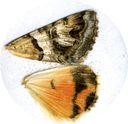
The combination of vermilion hindwings with dark postmedian band and marginal blotches, together with the complex patterned forewings featuring violet gray terminal area, distinguishes this from other Drasteria. The specific wing venation pattern—particularly the prominent angles on 3, 4, and 6 of the postmedian line—provides additional diagnostic characters. The ocherous border and white shading on forewing veins 3 and 4 are notable field marks.
Images
Distribution
Recorded from California, North America. Specific associations within California are not documented in available sources.
Seasonality
are on wing from June to July.
More Details
Taxonomic History
Originally described as Syneda pulchra Barnes & McDunnough, 1918, later transferred to Drasteria. The basionym reflects its initial placement in the genus Syneda.
Observation Rarity
As of source date, iNaturalist records only 11 observations, suggesting this is infrequently encountered or underreported.