
Drasteria grandirena
Haworth, 1809
Figure-seven Moth, Great Kidney
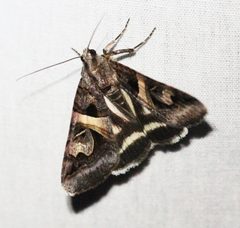
Drasteria grandirena, commonly known as the Figure-seven or Great Kidney, is a of owlet moth in the Erebidae. First described by Adrian Hardy Haworth in 1809, this small moth has a wingspan of approximately 35 mm. are active from March through August in California, with a broader North American distribution spanning eastern Canada to the southern United States. The species is notable for its larval association with witch-hazel.
Pronunciation
How to pronounce Drasteria grandirena: /dræsˈtɛriə ˌgrændɪˈriːnə/
These audio files are automatically generated. While they are not always 100% accurate, they are a good starting point.
Identification
The 'Figure-seven ' refers to a distinctive forewing pattern, presumably resembling the numeral 7, though precise diagnostic features require examination of specimens. The can be separated from other Drasteria species by geographic range and plant association. Confirmation typically requires genitalia dissection or molecular analysis, as is common for many noctuid moths.
Images
Appearance
Wingspan approximately 35 mm. Forewings display a pattern that gives the its 'Figure-seven ,' though specific wing pattern details are not fully documented in available sources. As a member of Drasteria, possess the typical underwing moth with forewings that provide camouflage and hindwings that are often more brightly colored, though this specific trait for D. grandirena is inferred from genus characteristics.
Distribution
Eastern North America from Ontario, Quebec and Nova Scotia south to at least Georgia, west to at least Arkansas. Present in Vermont. Records from California indicate western , though these may represent vagrancy or disjunct distribution requiring verification.
Seasonality
are on wing from March to August in California. period in other parts of the range is not specifically documented but presumably overlaps with or extends beyond this window.
Diet
Larvae feed on Hamamelis virginiana (American witch-hazel). feeding habits are not documented.
Host Associations
- Hamamelis virginiana - larval
Similar Taxa
- Drasteria mirificaCongeneric sharing similar underwing and defensive involving concealed brightly-colored hindwings; distinguished by specific wing patterns and geographic distribution
- Other Drasteria species members share general body plan and cryptic forewing patterns; -level identification requires detailed examination of wing markings and genitalia