
Catocala californica
Edwards, W.H., 1864
Western Underwing Moth
Catocala californica is a in the Erebidae, first described by William Henry Edwards in 1864. It belongs to the underwing moth Catocala, characterized by cryptic forewings that conceal brightly colored hindwings when at rest. The is found in western North America from British Columbia and Alberta south to California. are active during summer months, with larvae feeding on specific plants.
Pronunciation
How to pronounce Catocala californica: //ˌkætəˈkeɪlə ˌkælɪˈfɔrnɪkə//
These audio files are automatically generated. While they are not always 100% accurate, they are a good starting point.
Identification
Distinguished from other Catocala by geographic distribution in western North America combined with specific forewing and hindwing pattern details. Identification to species level requires examination of wing pattern characteristics and genitalia. Former edwardsi and elizabeth are now considered synonyms, reducing confusion in identification.
Images
Appearance
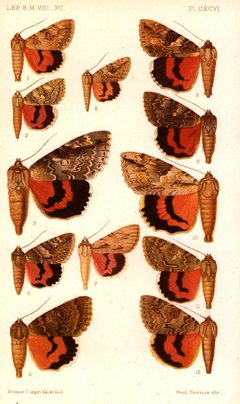
Wingspan approximately 65 mm. Like other Catocala , forewings are typically cryptic and held together over the back at rest, concealing the hindwings beneath. Hindwings display the bold coloration characteristic of underwing moths.
Habitat
Found in western North American ranging from British Columbia and Alberta through Washington and Oregon to California. Specific microhabitat preferences are not well documented in available sources.
Distribution
Western North America: British Columbia and Alberta south through Washington and Oregon to California.
Seasonality
on wing from June to August, with exact timing varying by location within the range.
Diet
Larvae feed on Juglans nigra (black walnut) and Salix (willows). feeding habits are not documented in available sources.
Host Associations
- Juglans nigra - larval black walnut
- Salix - larval willow
Life Cycle
Complete with , larval, pupal, and stages. Larval stage feeds on plants; adult occurs June to August. Specific details of site and stage are not documented.
Behavior
rest with forewings folded together over the back, concealing the brightly colored hindwings—a posture characteristic of the . This likely serves as avoidance .
Ecological Role
Larval herbivore on woody plants; specific functions are not well documented. As a member of the underwing group, may serve as prey for including bats and birds.
Human Relevance
No significant documented interactions with humans. Not known to be an agricultural pest. Of interest to lepidopterists and naturalists studying western North American fauna.
Similar Taxa
- Other Catocala speciesMany Catocala share similar cryptic forewing and colorful hindwing patterns; precise identification requires detailed examination of wing markings and genitalia.
More Details
Taxonomic History
Former Catocala californica edwardsi and Catocala californica elizabeth are now considered synonyms, simplifying the of this .
Sources and further reading
- BugGuide
- Wikipedia
- GBIF taxonomy match
- iNaturalist taxon
- NCBI Taxonomy
- Catalogue of Life
- A Gathering of Lepidopterists: Who's Who of the Butterfly, Moth Experts | Bug Squad
- The Big 43: The California Native Plants, Plus One, Studied in UC Davis Research | Bug Squad
- Bohart Museum: Learn about California's State Insect on UC Davis Picnic Day | Bug Squad
- A Mural Like No Other | Bug Squad
- A Flash of Orange: Welcome, California Tortoiseshell! | Bug Squad
- California Dogface Butterfly: What the Fire Did | Bug Squad