
Phytometra ernestinana
(Blanchard, 1840)
Ernestine's Moth
Ernestine's (Phytometra ernestinana) is a small moth in the Erebidae, originally described from Cuba in 1840. It has a broad North American distribution spanning the eastern and central United States plus southern Ontario. The belongs to the Boletobiinae, a group of generally small, often colorful moths. Despite its wide range, detailed biological information remains limited.

Pronunciation
How to pronounce Phytometra ernestinana: /faɪtoʊˈmiːtrə ɛrnɛˈstiːnənə/
These audio files are automatically generated. While they are not always 100% accurate, they are a good starting point.
Identification
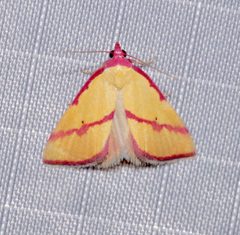
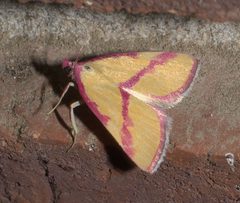
Distinguished from similar Phytometra by the combination of yellowish-orange forewing ground color with well-defined dark discal spot and relatively plain hindwings. P. rhodarialis has more uniformly pinkish or rosy forewings. P. apicimacula shows more prominent dark patches. Genitalia examination may be required for definitive identification of worn specimens.
Images
Appearance
Small with forewings that are yellowish to orangish-brown, often with darker brown or purplish-brown markings. A distinct dark discal spot is usually present. Hindwings are paler, typically whitish or pale yellowish with a faint darker terminal line. Wingspan approximately 15-20 mm.
Habitat
Found in open, disturbed including fields, meadows, roadsides, and suburban areas. Associated with herbaceous vegetation and low-growing plants.
Distribution
Eastern and central North America: Alabama, Arizona, Florida, Georgia, Illinois, Indiana, Iowa, Kansas, Louisiana, Michigan, Mississippi, New York, North Carolina, Ohio, Oklahoma, Ontario, South Carolina, Tennessee, Texas, Wisconsin, and Cuba.
Seasonality
have been recorded from March through November, with peak activity during summer months. Multiple likely occur in southern portions of range.
Human Relevance
No significant economic importance. Occasionally attracted to light at residential settings.
Similar Taxa
- Phytometra rhodarialisSimilar size and wing shape, but forewings are more uniformly pinkish-rose without contrasting yellowish ground color
- Phytometra apicimaculaHas more prominent dark patches at wing apex rather than central discal spot pattern
More Details
Original description
Originally described as Nanthilda ernestinana by Émile Blanchard in 1840 based on Cuban specimens. The Phytometra was established later, with this subsequently transferred to it.