
Syntomeida melanthus
(Cramer, 1779)
Black-banded Wasp Moth
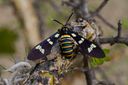
Syntomeida melanthus, the black-banded , is a day-flying arctiine moth native to the southwestern United States, Mexico, Central America, and northern South America. exhibit wasp-mimicry with contrasting coloration and are active during spring and fall in the United States. The was described by Pieter Cramer in 1779 and belongs to a known for sequestering cardiac glycosides from plants.
Identification
The black-banded can be distinguished from the closely related polka-dot wasp moth (Syntomeida epilais) by its black-banded wing pattern rather than white polka-dots on a blue-black background. Within its range, it may be confused with other syntomine wasp moths; precise identification requires examination of wing pattern details and geographic location. are and wasp-like in , unlike most moths.
Images
Habitat
Found in arid and semi-arid regions including desert scrub, thorn forest, and tropical dry forest. In the United States, occurs in desert and semi-desert of Arizona and Texas.
Distribution
Native to the southwestern United States (Arizona, southern and western Texas), Mexico, Guatemala, Honduras, Nicaragua, Rica, Venezuela, and the West Indies.
Seasonality
In the United States, are on wing from April to June and again from August to November, with two periods suggesting or partially bivoltine . Activity patterns in tropical portions of the range are less documented.
Diet
Larvae feed on a wide range of plants, primarily in the Convolvulaceae. Specific plant records include morning glories and related .
Host Associations
- Convolvulaceae - larval primary
Life Cycle
Complete with , larva, pupa, and stages. Larvae are presumably aposematically colored like , though specific descriptions are not documented in available sources. likely occurs in sheltered locations.
Behavior
are and exhibit -mimicry in . Like other Syntomeida , adults may engage in ultrasonic during courtship, though this has not been specifically documented for S. melanthus.
Ecological Role
As a herbivore, larvae contribute to nutrient cycling through consumption of Convolvulaceae foliage. The participates in mimicry complexes involving -mimicry and likely aposematism derived from of plant secondary compounds.
Human Relevance
Not considered a major agricultural pest, though larvae may feed on ornamental Convolvulaceae. The contributes to biodiversity in aridland and may serve as a of flowers visited by .
Similar Taxa
- Syntomeida epilaisSimilar -mimic appearance and , but distinguished by white polka-dot pattern on blue-black body versus black bands; also differs in distribution, with S. epilais primarily southeastern United States and Caribbean
- Empyreuma pugioneAnother oleander-feeding with similar , but has spotted orange and black coloration rather than banded pattern
More Details
Subspecies
Two recognized: Syntomeida melanthus melanthus (widespread) and Syntomeida melanthus albifasciata Butler, 1876 (Honduras, Mexico).
Sources and further reading
- BugGuide
- Wikipedia
- GBIF taxonomy match
- iNaturalist taxon
- NCBI Taxonomy
- Catalogue of Life
- Doubling down on defense: The polka-dot wasp moth, Syntomeida epilais — Bug of the Week
- Two beauties doubling down on defense: The polka-dot wasp moth, Syntomeida epilais, and spotted oleander caterpillar moth, Empyreuma pugione — Bug of the Week
- Bugs in Orange and Black III – Argus tortoise beetle, Chelymorpha cassidea; oleander caterpillar, Syntomeida epilais; and wheel bug, Arilus cristatus (MISSING LINKS) — Bug of the Week
- Noctuidae | Beetles In The Bush | Page 3
- Notodontidae | Beetles In The Bush