
Dahana atripennis
Grote, 1875
Black-winged Dahana, Black-winged Dahana Moth
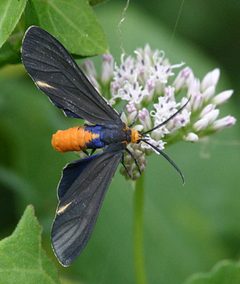
Dahana atripennis, commonly known as the Black-winged Dahana, is a in the Arctiinae (tiger moths). First described by Augustus Radcliffe Grote in 1875, this species is restricted to the southeastern United States. are active year-round in Florida, with larvae feeding specifically on Spanish moss (Tillandsia usneoides).

Pronunciation
How to pronounce Dahana atripennis: //dəˈheɪnə ætɹɪˈpɛnɪs//
These audio files are automatically generated. While they are not always 100% accurate, they are a good starting point.
Identification
The combination of black forewings, medium size (33–40 mm wingspan), and geographic restriction to Florida and Georgia distinguishes this from related tiger moths. The specific association with Tillandsia usneoides may aid in identification where the host plant is present. Similar dark-winged Arctiinae in the region require careful comparison of genitalia or molecular markers for definitive separation.
Images
Habitat
Associated with supporting its larval plant, Tillandsia usneoides (Spanish moss). This epiphytic bromeliad grows on trees in humid subtropical environments, particularly in live oak and cypress hammocks, swamps, and coastal woodlands of the southeastern United States.
Distribution
to the southeastern United States. Documented from Florida and Georgia. Distribution appears limited to the range of its plant Tillandsia usneoides, which is native to the southeastern coastal plain from Virginia to Texas.
Seasonality
are on wing year-round in Florida, indicating continuous breeding activity in subtropical climates. No specific seasonal peaks have been documented.
Diet
Larvae feed exclusively on Tillandsia usneoides (Spanish moss), an epiphytic bromeliad. feeding habits are not documented.
Host Associations
- Tillandsia usneoides - larval food plantSpanish moss; epiphytic bromeliad
Life Cycle
Complete (holometabolous). Larval stage feeds on Tillandsia usneoides. and details are not documented. Year-round adult activity in Florida suggests overlapping without distinct seasonal .
Behavior
Specific behavioral observations beyond activity are not documented in available sources. are , as typical for Arctiinae.
Ecological Role
Larvae function as herbivores on Tillandsia usneoides. Their role in nutrient cycling and dynamics within epiphytic has not been studied. Potential as prey for birds, bats, and other is inferred from general Arctiinae but not specifically documented.
Human Relevance
No documented economic or medical significance. The is not known to be a pest. Occasional subject of interest for lepidopterists and naturalists in Florida and Georgia.
Similar Taxa
- Other Dahana species Dahana contains related that may overlap in distribution; D. atripennis distinguished by black forewings and geographic range
- Dark-winged Arctiinae (e.g., some Cisthene, Lithosia)Similar black or dark forewing coloration occurs in unrelated Arctiinae; requires examination of wing venation, genitalia, or association for separation
More Details
Taxonomic History
Originally described by Grote in 1875. placement has shifted from to Erebidae ( Arctiinae) following modern molecular phylogenetic revisions of Lepidoptera.
Conservation Status
Not formally assessed. Likely secure given broad distribution of plant, though loss in coastal Florida and Georgia could impact local .