
Stigmella caryaefoliella
(Clemens, 1861) van Nieukerken et al., 2016
hickory leafminer
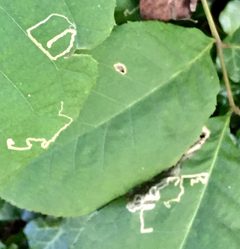
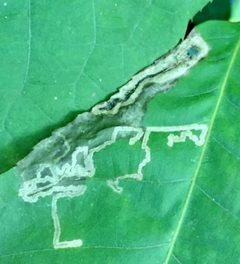
Stigmella caryaefoliella is a pygmy leaf-mining moth in the Nepticulidae, native to North America. The is a herbivore whose larvae feed on hickory (Carya) leaves, creating distinctive serpentine mines. are minute, typically measuring only 2–5 mm in wingspan, with reduced mouthparts. The species was originally described as Nepticula caryaefoliella by Clemens in 1861 and later transferred to Stigmella.
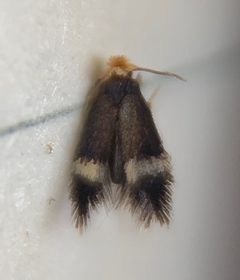
Pronunciation
How to pronounce Stigmella caryaefoliella: //ˈstɪɡmɛlə ˌkɛəriəfoʊliˈɛlə//
These audio files are automatically generated. While they are not always 100% accurate, they are a good starting point.
Identification
are distinguished from other Stigmella by genital , particularly the male and female ovipositor structure, requiring microscopic examination. The larval mines on hickory leaves are diagnostic: narrow, serpentine tracks that widen slightly as the larva matures, with deposited as a central line. Distinguished from Phyllonorycter species by the linear (rather than blotch) mine shape. Distinguished from other Stigmella species on hickory by mine pattern and association, though definitive identification requires rearing adults.
Images
Habitat
Deciduous forests and woodlands where hickory (Carya) occur, including riparian corridors and upland hardwood forests. Found in both mature forest stands and fragmented woodland patches. The species is closely tied to the presence of its plants.
Distribution
Nearctic region: documented from the eastern and central United States, with records including Vermont and other northeastern states. Distribution corresponds broadly with the range of native hickory .
Seasonality
have been observed from spring through summer, with peak activity likely corresponding to leaf flush on plants. Larval mining occurs during the growing season. Specific periods vary by latitude.
Diet
Larva feeds as a on hickory (Carya) , consuming mesophyll tissue between upper and lower leaf . mouthparts are reduced; feeding if any has not been documented.
Host Associations
- Carya - obligate Larval plant; specific hickory not definitively documented in available sources
Life Cycle
Holometabolous. are laid on hickory leaves. Larvae mine leaves, progressing through several instars. occurs either within the mine or in a cocoon on the ground. emerge to mate and oviposit. Voltinism (number of per year) not definitively established; likely or depending on latitude.
Behavior
Larvae are endophytic, feeding entirely within leaf tissue. are or , attracted to light. Mating and oviposition have not been specifically described.
Ecological Role
As a , larvae create small- disturbances in leaf tissue that may affect photosynthetic capacity of trees. The serves as prey for and other natural enemies, though specific parasitoid associations have not been documented. Contributes to nutrient cycling through deposition.
Human Relevance
Minor economic significance; leaf mining damage is generally cosmetic and does not threaten tree health. The is of interest to lepidopterists and natural historians documenting insect-plant associations. Records contribute to biodiversity monitoring and ecological studies of forest .
Similar Taxa
- Stigmella castaneaefoliellaSimilar leaf-mining habit on Fagales ; distinguished by host association (Castanea vs. Carya) and genital
- Phyllonorycter caryaecolellaAlso feeds on hickory; distinguished by blotch-shaped (rather than serpentine) leaf mines and placement of
More Details
Taxonomic history
Originally described in the Nepticula by James Clemens in 1861, the was transferred to Stigmella following taxonomic revisions of the Nepticulidae by van Nieukerken and colleagues in 2016.
Conservation status
Not evaluated by IUCN. The appears secure given the widespread distribution of hickory species in eastern North America, though local may be affected by loss or hickory decline.