
Ectoedemia similella
(Braun, 1917) Wilkinson et al., 1981
Broken-banded Ectoedemia Moth
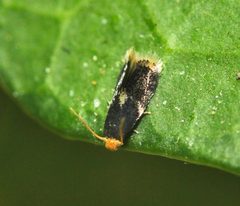
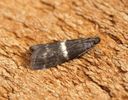
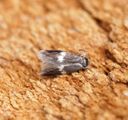
Ectoedemia similella is a minute in the Nepticulidae, commonly known as the Broken-banded Ectoedemia Moth. It is native to eastern North America, with confirmed records from Ohio and Kentucky. The has a wingspan of only 5–6 mm. Its larvae are leaf miners that feed exclusively on pin oak (Quercus palustris).
Pronunciation
How to pronounce Ectoedemia similella: /ˌɛktoʊɪˈdiːmiə ˌsɪmɪˈlɛlə/
These audio files are automatically generated. While they are not always 100% accurate, they are a good starting point.
Identification
The combination of minute size (5–6 mm wingspan), eastern North American distribution, and association with Quercus palustris distinguishes this . The specific epithet "similella" and "Broken-banded" suggest pattern similarities to related species, requiring genitalia dissection or for definitive identification. Leaf mines on pin oak with the characteristic of Ectoedemia larvae provide the most reliable field indicator.
Images
Appearance
are extremely small with a wingspan of 5–6 mm. As a member of Nepticulidae, it likely exhibits the 's characteristic reduced wing venation and forewings with distinctive patterning that inspired the "Broken-banded." Specific coloration details of adults are not documented in available sources.
Habitat
Associated with pin oak (Quercus palustris), indicating occurrence in wetland forests, floodplains, and moist lowland woods where this tree grows. The specific requirements of are unknown.
Distribution
Eastern North America; confirmed from Ohio and Kentucky in the United States. GBIF records indicate Nearctic region distribution.
Diet
Larvae feed exclusively on Quercus palustris (pin oak), mining the leaves. feeding habits are unknown.
Host Associations
- Quercus palustris - larval Leaves are mined by larvae
Life Cycle
Larvae mine leaves of Quercus palustris. Details of placement, site, number of , and stage are not documented.
Behavior
Larvae are leaf miners, creating tunnels within leaf tissue. is unknown.
Ecological Role
As a , larvae likely function as primary consumers of pin oak foliage, potentially affecting leaf photosynthetic capacity. Their role in as prey for and is inferred from the of related nepticulid but not specifically documented.
Similar Taxa
- Ectoedemia speciesMany Ectoedemia are minute, oak-associated leaf miners with overlapping distributions; reliable separation requires examination of genitalia or molecular data.
- Other NepticulidaeThe contains numerous similar-sized with reduced wing venation; plant association with Quercus palustris helps narrow identification.
More Details
Taxonomic history
Originally described as Nepticula similella by Braun in 1917, later transferred to Ectoedemia by Wilkinson et al. in 1981.
Observation frequency
The has relatively few documented observations (45 on iNaturalist as of source date), suggesting it is either genuinely rare, undercollected due to its minute size, or restricted in distribution by plant specificity.