
Gloveria
Packard, 1872
Species Guides
5- Gloveria arizonensis(Arizona Lappet)
- Gloveria gargamelle(Sooty Lappet)
- Gloveria howardi
- Gloveria medusa(Medusa Moth)
- Gloveria sphingiformis
Gloveria is a of lappet moths in the Lasiocampidae, established by Packard in 1872. All are to southern North America, ranging from the southwestern United States through Mexico. The genus is notable for caterpillars that exhibit communal foraging using trail-. Ten species are currently recognized, with distributions centered in arid and semi-arid regions of California, Arizona, Texas, Colorado, Utah, and Mexico.
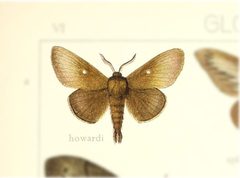
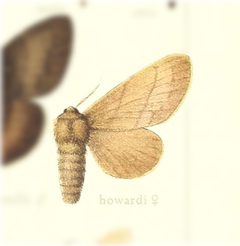
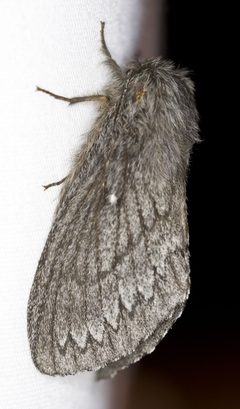
Pronunciation
How to pronounce Gloveria: //ɡloʊˈvɛriə//
These audio files are automatically generated. While they are not always 100% accurate, they are a good starting point.
Images
Distribution
Southern North America: southwestern United States (California, Arizona, Texas, Colorado, Utah) and Mexico. distributions are non-overlapping in some cases, with G. arizonensis spanning California to Texas and adjacent states, while other species are restricted to single states or Mexico.
Behavior
Caterpillars exhibit communal foraging , constructing shared nests and depositing trail- by dragging the surface of the abdominal tip along branch . Trail following requires reinforcement by multiple caterpillars; individually fed caterpillars cannot recruit hungry nestmates to new food sources. The system is -specific and does not respond to trails of the related Malacosoma americanum.
Similar Taxa
- MalacosomaRelated lasiocampid with similar communal caterpillar ; Gloveria differs in chemistry (does not respond to Malacosoma trails or 5β-cholestane-3-one) and lacks individual recruitment capability
More Details
Chemical Ecology
threshold sensitivity is approximately 0.5 × 10⁻³ caterpillar equivalents per centimeter of trail. The system is distinct from that of Malacosoma americanum.