
Heteropacha rileyana
Harvey, 1874
Riley's Lappet Moth
Heteropacha rileyana is a in the Lasiocampidae, the sole in its . It was historically misidentified as a clearwing moth (Sesiidae) due to superficial resemblance. The species exhibits -mimicking coloration with distinctive abdominal banding. Larvae feed on horse nettle (Solanum carolinense), a plant associated with sandy soils.
Pronunciation
How to pronounce Heteropacha rileyana: /ˌhɛt.ə.roʊˈpæk.ə ˌraɪ.liˈeɪ.nə/
These audio files are automatically generated. While they are not always 100% accurate, they are a good starting point.
Identification
Distinguished from clearwing moths (Sesiidae) by non-transparent wings and from other lappet moths by the combination of complete yellow abdominal banding on every segment and red forewing . The -mimicking appearance may cause initial confusion with hymenopterans or sesiid .
Images
Appearance
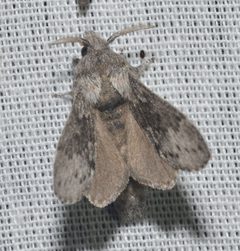
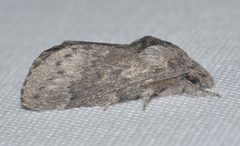
Medium-sized with -mimicking coloration. has every segment banded in yellow. Forewing possesses a red . Wings are not transparent (distinguishing it from true clearwing moths). Body form somewhat elongate, contributing to wasp-like appearance.
Habitat
Sandy areas, particularly around agricultural fields where horse nettle grows. Associated with disturbed sandy soils in river basins and similar deposits.
Distribution
United States: Mississippi, Missouri, Texas, and Georgia. Records from the upper Mississippi River Alluvial Basin.
Seasonality
fly late summer. Activity in September documented in Missouri, with possible bimodal pattern suggesting two in some regions.
Diet
Larva feeds on horse nettle (Solanum carolinense). diet not documented.
Host Associations
- Solanum carolinense - larval food planthorse nettle
Behavior
Males use to locate females for mating. Was historically attracted to synthetic pheromone lures intended for clearwing moth surveys.
Similar Taxa
- Synanthedon decipiensBoth exhibit -mimicking appearance with yellow abdominal banding, but S. decipiens is a true clearwing moth (Sesiidae) with transparent wings and larvae that bore in oak galls rather than feeding on herbaceous plants
- Sesiidae (clearwing moths)General resemblance due to convergent mimicry; distinguished by wing transparency, different larval (wood-borers), and -level characters
Misconceptions
Historically misidentified as Synanthedon decipiens and as a clearwing moth (Sesiidae) due to -mimicking appearance. The misidentification persisted in photographic records until corrected by William Taft.
More Details
Taxonomic history
Originally described by Harvey in 1874. The was long confused with clearwing moths due to convergent -mimicry, leading to misidentification in field guides and photographic records.
Pheromone biology
Males respond to female-emitted and were documented approaching synthetic pheromone lures used for Sesiidae surveys in the 1980s, contributing to identification confusion.