
Gracillaria syringella
(Fabricius, 1794)
lilac leafminer, privet leafminer, Lilac Leafminer Moth
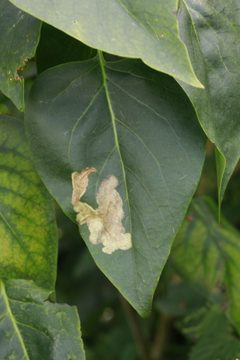
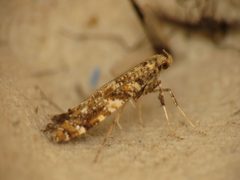
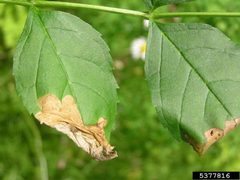
Gracillaria syringella is a small leaf-mining in the Gracillariidae, native to Europe and introduced to North America. have a wingspan of 10–13 mm and display distinctive pale yellow-brown forewings with white fasciae and black-margined spots. The is named for its larval association with lilac (Syringa), though it also mines leaves of privet (Ligustrum) and ash (Fraxinus). It produces two annually in most of its range.
Pronunciation
How to pronounce Gracillaria syringella: /ɡɹə.sɪlˈlɛɹ.i.ə sɪˈɹɪn.dʒɛl.ə/
These audio files are automatically generated. While they are not always 100% accurate, they are a good starting point.
Identification
Distinguished from similar Gracillariidae by the specific pattern of white fasciae and black-margined spots on yellow-brown forewings. The combination of oblique interrupted fascia at one-quarter, angulated fascia, and paired costal and terminal dots near apex is diagnostic. Dark grey hindwings contrast with lighter forewings. Larval mines on Oleaceae (Syringa, Ligustrum, Fraxinus) support identification where present.
Images
Habitat
Associated with plants in the Oleaceae, particularly in urban and suburban settings, gardens, parks, and hedgerows where lilac, privet, and ash are cultivated or naturalized.
Distribution
Native to Europe; introduced and established in North America with records from Canada (Alberta, British Columbia, New Brunswick, Newfoundland and Labrador, Nova Scotia) and presumably the northern United States.
Seasonality
fly in May and again in July, with timing varying by location; (two per year).
Diet
Larvae feed as leaf miners on ash (Fraxinus), privet (Ligustrum), and lilac (Syringa). Specific feeding mode (whether epidermal, parenchymal, or full-depth mining) not specified in sources.
Host Associations
- Fraxinus - larval ash
- Ligustrum - larval privet
- Syringa - larval lilac
Life Cycle
with two periods annually. Larval development occurs within leaves of plants. Specific details of site and stage not provided in sources.
Behavior
are or . Larvae are endophagous leaf miners, feeding internally within leaf tissue.
Ecological Role
As a , larvae modify leaf tissue of plants, potentially affecting photosynthetic capacity. Introduced in North America represent a novel herbivore on native and ornamental Oleaceae.
Human Relevance
Considered a minor pest of ornamental lilac and privet in gardens and landscapes. The ' reflect its association with cultivated plants.
Similar Taxa
- Other Gracillariidae on OleaceaeSeveral Gracillariidae mine Oleaceae leaves; G. syringella is distinguished by its specific wing pattern and range including Syringa, Ligustrum, and Fraxinus.
More Details
Taxonomic history
Originally described as Tinea syringella by Fabricius in 1794.