
Gracillaria
Haworth, 1828
Species Guides
1- Gracillaria syringella(lilac leafminer)
Gracillaria is a of small in the Gracillariidae, established by Adrian Haworth in 1828. The genus contains nine recognized distributed across Europe, Asia, and North America. Members of this genus are leaf-mining moths, with larvae that feed internally on plant tissue. The type species, Gracillaria syringella, was described by Fabricius in 1794 and is known to feed on lilac and privet.
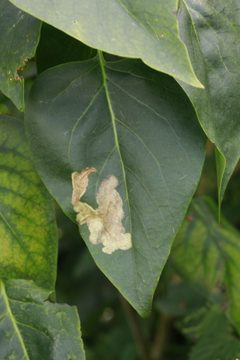
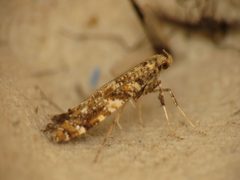
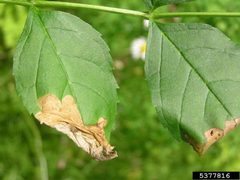
Pronunciation
How to pronounce Gracillaria: /ˌɡræˌsɪˈlɛəriə/
These audio files are automatically generated. While they are not always 100% accurate, they are a good starting point.
Images
Distribution
Europe (Denmark, Norway, Sweden), Asia (Japan, Russia), and North America (Vermont, United States). Specific distribution varies by .
Host Associations
- Syringa - larval G. syringella feeds on lilac
- Ligustrum - larval G. syringella feeds on privet
Human Relevance
Gracillaria syringella is occasionally noted as a minor pest of ornamental lilac and privet hedges, though damage is generally limited.
Similar Taxa
- PhyllonorycterBoth are Gracillariidae with leaf-mining larvae; Phyllonorycter typically create blotch mines on upper leaf surfaces while Gracillaria species often form linear or tentiform mines
More Details
Type species
Gracillaria syringella (Fabricius, 1794) is the type of the
Nomenclatural note
The name Gracillaria has been conserved over the homonym Gracillaria Haworth, 1811 (a misspelling of Gracillaria in Lepidoptera)