
Aplocera plagiata
(Linnaeus, 1758)
Treble Bar, St. John's Wort Inchworm
Aplocera plagiata, commonly known as the Treble Bar or St. John's Wort Inchworm, is a in the Geometridae. It occurs throughout the Palearctic region and the Near East, with introduced in North America. The is associated with St. John's wort (Hypericum) as a larval plant. are active during summer months and are readily recognized by their distinctive wing pattern.


Pronunciation
How to pronounce Aplocera plagiata: //ˌæpləˈsɪərə ˌplædʒɪˈeɪtə//
These audio files are automatically generated. While they are not always 100% accurate, they are a good starting point.
Identification
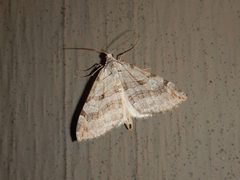
Distinguished from similar Aplocera and other banded geometrids by the presence of three well-defined dark bands on the forewing. The combination of three bands (rather than two or four), the relatively broad band, and the brownish-grey ground color separates it from such as Aplocera efformata, which has narrower and less contrasting bands.
Images
Appearance
Medium-sized geometrid with wingspan approximately 35–40 mm. Forewings brownish-grey with three prominent dark transverse bands: a basal band, a band, and a terminal band. The median band is often the most distinct and may appear slightly wavy. Hindwings paler, with two weaker bands. Body slender, matching forewing ground color.
Habitat
Open including grasslands, meadows, woodland edges, and disturbed areas where plants grow. Found from lowlands to moderate elevations.
Distribution
Native to the Palearctic region including Europe and northern Asia (excluding China). Present in the Near East. Introduced and established in North America, including the northeastern United States and adjacent Canada. Records from Belgium confirm presence in Western Europe.
Seasonality
active primarily June through August in temperate regions. Single-brooded () in most of range, with peak period in mid-summer.
Diet
Larva feeds on Hypericum (St. John's wort), including Hypericum perforatum and related species. feeding habits not well documented; may take nectar or not feed.
Host Associations
- Hypericum perforatum - larval
- Hypericum - larval -level association
Life Cycle
Complete with four stages: , larva (inchworm/caterpillar), pupa, and . Larva is typical geometrid 'looper' with reduced , moving with characteristic looping gait. Overwinters as pupa in soil or leaf litter. Adults emerge in summer.
Behavior
are and attracted to light. Larvae are solitary feeders on plant foliage. occurs in soil or concealed locations.
Ecological Role
Larva acts as a herbivore on Hypericum, potentially contributing to of weedy St. John's wort . Serves as prey for and .
Human Relevance
Larval feeding on Hypericum perforatum, an weed in some regions, has led to interest in this as a potential agent. Otherwise of minor economic significance. is a familiar to naturalists and contributes to biodiversity records.
Similar Taxa
- Aplocera efformataSimilar banded pattern but with narrower, less contrasting bands; often requires genitalia examination for definitive separation
- Other Aplocera speciesDiffer in number, width, or intensity of transverse bands on forewing
More Details
Etymology
Specific epithet 'plagiata' refers to the oblique or slanting bands on the wings. 'Treble Bar' describes the three prominent wing bands; 'St. John's Wort Inchworm' refers to larval association and typical geometrid larval locomotion.