
Hydriomena furcata
(Thunberg, 1784)
July Highflyer
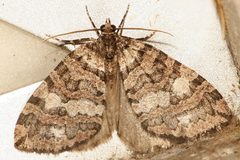
Hydriomena furcata, the July Highflyer, is a Holarctic geometrid described by Carl Peter Thunberg in 1784. display exceptional color , with forewings ranging from olive green through grey to reddish brown, marked by variable dark cross bands. The is , with adults active in July and August, and overwinters as . Larvae are defoliators of deciduous plants, with documented significant impact on heather growth in northern England moorlands.


Pronunciation
How to pronounce Hydriomena furcata: /hɪd.ɹiˈoʊ.mɛ.nə fɜːrˈkeɪ.tə/
These audio files are automatically generated. While they are not always 100% accurate, they are a good starting point.
Identification
The combination of highly variable forewing coloration (green to brown) with dark, wavy cross bands and streak is characteristic. Critical separation from requires examination of genitalia or pupal bristles. In Europe, differs from other Hydriomena by shorter palpus, irregular markings between subbasal and lines, interrupted dark subterminal band with pale central spot, and lack of apical black -streaks. Males can be identified by genital structure; females are more difficult to distinguish.
Images
Habitat
Moorland areas in sub-alpine and montane regions, hedgerows, woodland margins, and suburban areas. Associated with heather moorlands where larvae can reach high densities.
Distribution
Holarctic distribution. Europe: widespread from Portugal and Ireland across to Russia; abundant in northern Europe, local in central Europe, scarce in southern Europe. Asia: Caucasus, Transcaucasia, Urals, Kazakhstan, Siberia, Russian Far East, northern Mongolia, China, Korea, Japan. North America: Alaska through Canada to Newfoundland, widespread in United States.
Seasonality
on wing July to August (peak activity gives rise to ). : one per year. Overwinters as stage.
Diet
Larvae feed on leaves of various broad-leaved trees and shrubs: willow (Salix caprea), poplar (Populus tremula), alder (Alnus), birch (Betula), hazel (Corylus avellana), rose (Rosa), bilberry/blueberry (Vaccinium myrtillus), and heather (Calluna vulgaris). Late instar larvae spin small silken feeding webs on mature heather plants.
Host Associations
- Salix caprea - larval food plantgoat willow
- Populus tremula - larval food plantaspen
- Alnus - larval food plantalder
- Betula - larval food plantbirch
- Corylus avellana - larval food planthazel
- Rosa - larval food plantrose
- Vaccinium myrtillus - larval food plantbilberry/blueberry; females lay on leaf undersides
- Calluna vulgaris - larval food plantheather; late instar larvae construct silken feeding webs
Life Cycle
cycle. laid in small groups on undersides of leaves (particularly Vaccinium myrtillus), overwinter in this stage. Larvae emerge spring to early summer, feed on foliage; late instars construct silken webs on heather. occurs in soil or leaf litter. emerge July–August. Both and activity; attracted to light.
Behavior
exhibit both and activity. Males and females attracted to light traps. Larvae are external leaf feeders; late instars construct silken feeding shelters on heather. High densities can develop in favorable moorland .
Ecological Role
Herbivore and significant defoliator in moorland . One study estimated larvae consumed 50% of growth of mature heather in a northern England moorland region, indicating potential for substantial impact on vegetation structure and nutrient cycling in heathland .
Human Relevance
Occasional pest in forestry and horticulture due to larval defoliation of broad-leaved trees and shrubs. sequenced as part of Lepidoptera genomic research (Wellcome Sanger Institute, 2024); assembly 423.3 Mb with 28 chromosomal pseudomolecules. Subject of ecological studies on plant-herbivore interactions in moorland systems.
Similar Taxa
- Other Hydriomena speciesShare similar wing patterns and preferences; require genital examination or pupal bristles for reliable identification.
- Other Larentiinae moths with banded forewingsSimilar cryptic coloration and wing patterns; Hydriomena furcata distinguished by combination of angled forewing base, interrupted subterminal band, and absence of -streaks.
More Details
Genome sequencing
assembly from male specimen collected at Wytham Woods, Oxfordshire, UK: 423.3 Mb nuclear genome, 28 chromosomal pseudomolecules (27 + Z ), 15.89 kb mitochondrial genome, 17,324 protein-coding genes.
Subspecies
Three recognized : H. f. furcata (Thunberg, 1784), H. f. fergusoni McDunnough, 1954, and H. f. saga (Prout, 1938).
Sources and further reading
- BugGuide
- Wikipedia
- GBIF taxonomy match
- iNaturalist taxon
- NCBI Taxonomy
- Catalogue of Life
- Bodil Cass and 'The Curious Case of Katydids in California Citrus' | Bug Squad
- Bug Eric: Fork-tailed Bush Katydid
- 🪲 Entomologizing w/ the WGNSS Entomology Group at Hughes Mountain Natural Area — 11 Oct 2025 | Beetles In The Bush
- Bug Eric: Grand Finale
- The genome sequence of the July Highflyer, Hydriomena furcata (Thunberg, 1784).