
Anticlea
Kunth, 1843
Species Guides
4- Anticlea multiferata(Many-lined Carpet Moth)
- Anticlea pectinata
- Anticlea switzeraria
- Anticlea vasiliata(Variable Carpet Moth)
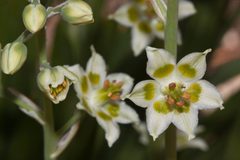
Anticlea is a of flowering plants in the Melanthiaceae, tribe Melanthieae. Molecular phylogenetic studies have confirmed its separation from the formerly congeneric Zigadenus, with which it was long synonymized. The genus comprises herbaceous bulbous plants, including the relict A. sibirica, which marks historical distributions of Pleistocene hemiboreal pine–birch–larch forests. Species occupy montane across northern Asia and North America.
Pronunciation
How to pronounce Anticlea: /ænˈtɪkliə/
These audio files are automatically generated. While they are not always 100% accurate, they are a good starting point.
Identification
Anticlea can be distinguished from Zigadenus, into which it was formerly submerged, by molecular and morphological characters; specific diagnostic features require examination of floral and vegetative . Members of the are herbaceous perennials arising from bulbs.
Images
Habitat
Montane environments including dry light coniferous forests with deciduous Larix, hemiboreal pine–birch–larch forests, rocky outcrops, riverbanks, screes, steep riverbanks, and rock ledges. Strongly confined to mountainous terrain with sharply continental climate conditions.
Distribution
Northern Asia: Western and Eastern Siberia, Far East, Middle and Southern Urals, northern Mongolia, China, Japan, Korean Peninsula; isolated western in Southern Urals (Republic of Bashkortostan, Perm Krai, Sverdlovsk and Chelyabinsk Regions); main Asian range includes Krasnoyarsk Krai, Republic of Sakha, Khabarovsk and Primorsky Krais, Zabaykalsky Krai, republics of Buryatia, Tuva, Khakassia, Kemerovo Region, southern Irkutsk Region, southeastern Altai Krai, northern Altai Republic; suitable also in Magadan Region, Kamchatka, Sakhalin, Amur Region. North American distribution present but not detailed in available sources.
Life Cycle
Herbaceous bulbous plant. Specific details of germination, flowering , and seed not documented in available sources.
Ecological Role
such as A. sibirica serve as potential indicators of hemiboreal pine–birch–larch forest distribution during the Pleistocene; presence suggests historical extent of these relict .
Similar Taxa
- ZigadenusFormerly congeneric with Anticlea; separated based on 21st-century molecular phylogenetic studies confirming distinct phylogenetic position
- StenanthiumSome moved from Stenanthium into Anticlea based on molecular phylogenetic revisions of tribe Melanthieae
More Details
Taxonomic History
Anticlea was long submerged in Zigadenus; its resurrection as a distinct and the transfer of from Stenanthium reflect major revisions to Melanthieae based on molecular in the 21st century.
Climate Change Vulnerability
Modeling of A. sibirica under moderate climate change (RCP4.5) indicates potential range expansion to the northeast along the Sea of Okhotsk coast, but overall decrease in suitable area across most of the range; persistence in deteriorating conditions likely limited to low-competition refugia such as rocky outcrops and riverbanks.