
Eupithecia russeliata
Swett, 1908
A small North American geometrid first described in 1908. are active from May through October and have been documented visiting apple flowers at night, contributing to pollination. The is widespread across Canada and the United States, with larvae feeding on spruce and possibly other conifers.
Pronunciation
How to pronounce Eupithecia russeliata: //juːˈpɪθ.i.ə ˌrʌsˈliː.eɪ.tə//
These audio files are automatically generated. While they are not always 100% accurate, they are a good starting point.
Identification
Members of Eupithecia are recognized by their narrow wings and distinctive resting posture. -level identification within the is notoriously difficult and typically requires examination of genitalia characters. This species may be separated from similar Eupithecia by geographic distribution and period, though definitive identification usually necessitates dissection.
Images
Appearance
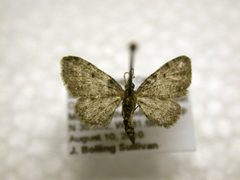
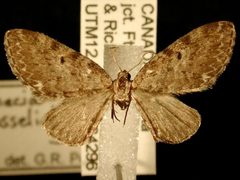
Wingspan approximately 18 mm. As a member of the Eupithecia, possesses narrow wings and a characteristic resting posture typical of 'pug' . Specific coloration and pattern details for this are not well documented in available sources.
Habitat
Associated with coniferous forests, particularly those containing spruce (Picea). The dry, mixed conifer forest with oaks at 7,000 feet elevation in New Mexico represents documented for the in the southwestern United States.
Distribution
Widespread in North America. Documented from: Alberta, California, Kentucky, Maine, Maryland, Minnesota, New Brunswick, Newfoundland and Labrador, North Carolina, Nova Scotia, Manitoba, and Saskatchewan.
Seasonality
recorded on wing from May to October.
Diet
Larvae feed on Picea (spruce) and possibly other conifers.
Host Associations
- Picea - larval food plantspruce
- Malus domestica - visitationobserved visiting apple flowers at night, contributing to pollination
Behavior
are and attracted to light. Has been observed visiting apple flowers at night, indicating potential role in nocturnal pollination.
Ecological Role
Larval herbivore on conifers; documented as of apple.
Human Relevance
Documented participant in pollination of apple crops. may be encountered at light traps in forested areas.
Similar Taxa
- Other Eupithecia speciesNarrow wings and resting posture are shared traits; identification requires genitalia examination
- Other GeometridaeSimilar size and general form; Eupithecia distinguished by wing shape and posture