
Eupithecia lariciata
(Freyer, 1841)
Larch Pug
Eupithecia lariciata, commonly known as the larch pug, is a small in the Geometridae. It is widely distributed across the Northern Hemisphere, occurring in Europe, Asia, and North America. The has been documented visiting apple flowers, contributing to pollination services in orchard . Like other members of the Eupithecia, it exhibits the characteristic narrow-winged and distinctive resting posture typical of 'pug' moths.
Pronunciation
How to pronounce Eupithecia lariciata: /juː.pɪˈθiː.ki.ə ləˈrɪ.si.ə/
These audio files are automatically generated. While they are not always 100% accurate, they are a good starting point.
Identification
Members of the Eupithecia are readily recognized by their narrow wings and unique resting posture. Specific identification of E. lariciata to level typically requires examination of genitalia or detailed wing pattern analysis, as many Eupithecia species are superficially similar. The species is associated with larch (Larix), which may provide a cue. Differentiation from congeneric species relies on subtle differences in wing pattern, size, and genital .
Images
Appearance
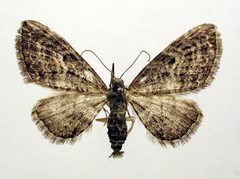
Small with narrow wings and a compact body. As a member of the Eupithecia, it exhibits the characteristic 'pug' : wings are typically held flat or slightly overlapping at rest, with a relatively short, broad body compared to wing length. Wing patterns are generally subdued, with fine lines and mottled gray-brown coloration typical of the genus. are small enough to be considered 'micros' by some definitions, though larger than many related geometrid groups.
Habitat
Associated with coniferous forests, particularly those containing larch (Larix). In North America, has been recorded in dry, mixed conifer forest at elevations around 7,000 feet. The occurs in and montane forest zones across its range.
Distribution
Europe; Ural Mountains; West and Central Siberia; Altai Mountains; Transbaikalia; Yakutia; Russian Far East; Mongolia; Korea; Japan; North America from Yukon and Newfoundland south to New York and Arizona.
Diet
Larval : Larch (Larix). have been observed visiting apple flowers, suggesting nectar or pollen feeding.
Host Associations
- Larix - larval Larval food plant
- Malus - visitor observed on apple flowers; may contribute to pollination
Behavior
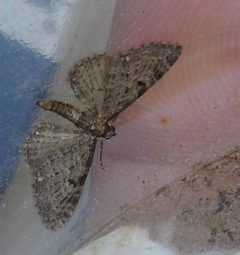
are and attracted to light. Documented visiting apple flowers at night, contributing to pollination. Resting posture is characteristic of the : wings typically held flat or slightly overlapping, giving a compact, narrow-winged appearance.
Ecological Role
Larval herbivore on larch. , documented contributing to apple pollination in orchard studies. Functions as part of the broader nocturnal insect providing pollination services to flowering plants.
Human Relevance
Documented as a of apple (Malus), with potential value in orchard pollination services. The illustrates the dual ecological roles of —as herbivores in larval stages and pollinators as .
Similar Taxa
- Other Eupithecia speciesMany congeneric share narrow-winged and similar resting posture; species-level identification requires detailed examination of genitalia or wing pattern
- Other GeometridaeBroad similarity in overall body plan, but Eupithecia distinguished by characteristic 'pug' narrow wings and compact resting posture
More Details
Pollination Ecology
A 2021 study in the Journal of Economic Entomology documented Eupithecia visiting apple flowers at night, demonstrating their contribution to pollination in agricultural systems. This finding supports broader recognition of moths as valuable beyond their often-categorized roles as agricultural pests.
Taxonomic Note
The Eupithecia is large and taxonomically complex, with many requiring dissection for reliable identification. The 'larch pug' reflects the larval association with Larix species.