
Eupithecia albicapitata
Packard, 1876
Spruce Cone Geometer
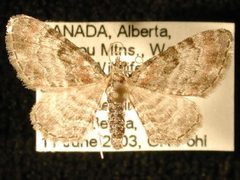
Eupithecia albicapitata is a small geometrid first described by Alpheus Spring Packard in 1876. It occurs across northern North America from Newfoundland to Alaska and south to New York. The has been documented visiting apple flowers, contributing to pollination services. As a member of the 'pug' Eupithecia, it exhibits the narrow-winged and distinctive resting posture characteristic of this diverse group.
Pronunciation
How to pronounce Eupithecia albicapitata: //juːˌpɪθiˈsiːə ælˌbaɪkæpɪˈtɑːtə//
These audio files are automatically generated. While they are not always 100% accurate, they are a good starting point.
Identification
Members of Eupithecia ('pugs') are recognized by their narrow wings and unique resting posture with wings held flat or slightly folded. Definitive identification within this typically requires examination of genitalia or other microscopic characters. The specific epithet 'albicapitata' may indicate a diagnostic pale or white marking, though this requires verification.
Images
Appearance
Small with wingspan 14–18 mm. Narrow wings typical of the Eupithecia. Coloration not explicitly described in available sources, though the specific epithet 'albicapitata' (white-headed) suggests pale markings on the .
Habitat
Associated with coniferous forests; specifically linked to spruce based on the 'Spruce Cone Geometer'. Observed at blacklight stations in dry, mixed conifer forest with oaks at 7,000 feet elevation in New Mexico. The ' broad transcontinental distribution suggests adaptability to various and temperate forest conditions.
Distribution
Transcontinental across northern North America: from Newfoundland and Labrador west to British Columbia, north to Alaska and Alberta, south to New England and New York. Records also from Manitoba and Saskatchewan.
Host Associations
- Picea - larval inferred from 'Spruce Cone Geometer'; specific plant records not confirmed in available sources
Behavior
; attracted to artificial light sources including blacklights and porch lights. Has been observed visiting apple flowers at night, indicating nectar-feeding and potential role in pollination.
Ecological Role
contribute to pollination of flowering plants, including agricultural crops such as apple. A 2021 study documented Eupithecia as nighttime visitors to apple flowers in Arkansas, demonstrating their capacity for pollination services comparable to insects.
Human Relevance
Potential value as in agricultural settings. Documented visiting apple flowers in commercial orchard studies, contributing to fruit set and seed development.
Similar Taxa
- Other Eupithecia speciesNarrow-winged and resting posture shared across ; -level identification requires specialized examination of genitalia or other microscopic characters.
- Other Geometridae-level characters of wing shape and body form; Eupithecia distinguished by particularly narrow wings and compact resting posture.
More Details
Taxonomic history
First described by Alpheus Spring Packard in 1876. The specific epithet 'albicapitata' derives from Latin 'albus' (white) and 'capitatus' (headed), presumably referring to a diagnostic pale marking.
Research significance
Featured in a 2021 Journal of Economic Entomology study on apple pollination, highlighting the underappreciated role of in agricultural .