
Venusia cambrica
Curtis, 1839
Welsh Wave, Welsh Wave Moth
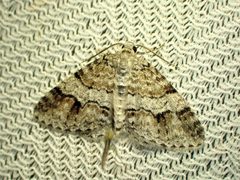
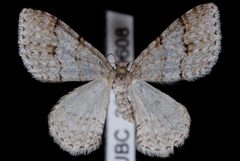
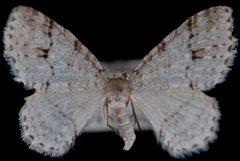
Venusia cambrica, the Welsh Wave, is a Holarctic geometrid with a broad distribution spanning Europe, Asia, and North America. are characterized by light grey forewings with distinctive black and brown cross lines, including two protruding black marks near the outer line. The exhibits variable phenotypic forms, including several named aberrations with altered wing patterns and coloration. Larvae are slender and green with purple and lateral spotting, feeding primarily on rowan leaves.
Pronunciation
How to pronounce Venusia cambrica: //vɛˈnuːsiə ˈkæm.brɪ.kə//
These audio files are automatically generated. While they are not always 100% accurate, they are a good starting point.
Identification
The two protruding black marks at the outer cross line on the forewing are diagnostic and distinguish V. cambrica from similar Venusia . The pattern recalls Oporinia (now included in broader Operophtera or related ) but differs in wing shape and precise line configuration. Aberration webbi specifically resembles Oporinia autumnata gueneata but retains costal and markings. Specimens from Scotland and continental Europe average whiter than English and Korean .
Images
Habitat
Damp woodlands and moorland regions. Associated with supporting the larval plant Sorbus aucuparia.
Distribution
Holarctic. Europe: widespread including Britain (northern and western areas), continental Europe. Asia: western and central Siberia, Altai, Transbaikalia, Russian Far East, Korean Peninsula, Japan (including Kuriles). North America: Canada from Newfoundland and Labrador to British Columbia, south to California in the west and Georgia in the east.
Seasonality
Western Europe: July to August (one ). New Brunswick and Quebec: June to September. California: March to August. Two generations per year in parts of range.
Diet
Larvae feed on leaves of Sorbus aucuparia (rowan, mountain ash). Additional recorded food plants include alder (Alnus), apple (Malus), birch (Betula), serviceberry (Amelanchier), and willow (Salix).
Host Associations
- Sorbus aucuparia - larval food plantprimary
- Alnus - larval food plantadditional recorded
- Malus - larval food plantadditional recorded
- Betula - larval food plantadditional recorded
- Amelanchier - larval food plantadditional recorded
- Salix - larval food plantadditional recorded
Life Cycle
Two per year in at least part of range. Larval stage feeds on plant leaves. details not documented in available sources.
Human Relevance
Subject of genomic research; sequenced with 470.40 Mb assembly, 38 chromosomal pseudomolecules, and 17,931 protein-coding genes. Moderately well-represented in citizen science observations.
Similar Taxa
- Oporinia autumnata gueneataWing pattern similarity, particularly in ab. webbi aberration; distinguished by retained markings at costal margin and in V. cambrica
- Other Venusia speciesShared characteristics; distinguished by the two protruding black marks at the outer cross line
More Details
Subspecies
V. c. cambrica: Holarctic region. V. c. aphrodite Bryk, 1942: Kurile Islands, Russia.
Genomic resources
Reference available: 470.40 Mb nuclear assembly with 37 + Z , 16.44 kb mitochondrial genome, 17,931 protein-coding genes. Specimen from Glenmore, Isle of Bute, Scotland.