
Nemoria saturiba
Ferguson, 1969
Red-patched Emerald
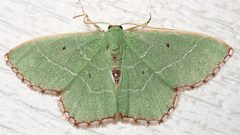
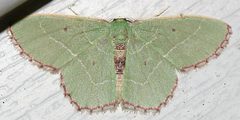
Nemoria saturiba is a small emerald moth in the Geometridae, described by Ferguson in 1969. It is distributed across the southeastern and mid-Atlantic United States, with a wingspan of approximately 20 mm. The larvae are specialized feeders on sweetgum (Liquidambar styraciflua).
Pronunciation
How to pronounce Nemoria saturiba: /nɛˈmoː.ri.a saˈtuː.ri.ba/
These audio files are automatically generated. While they are not always 100% accurate, they are a good starting point.
Identification
The can be distinguished from other Nemoria by geographic range and association with sweetgum plants. The "Red-patched Emerald" suggests a diagnostic reddish patch on the wings, though this requires verification from original description or detailed sources. Separation from similar emerald moths in the likely requires examination of genitalia or detailed wing pattern analysis.
Images
Appearance
Small emerald moth with a wingspan of approximately 20 mm. As a member of the emerald moth group (Geometrinae), likely display green coloration typical of the , though specific markings beyond the reference to a "red-patched" feature are not detailed in available sources.
Habitat
Associated with containing sweetgum (Liquidambar styraciflua), including bottomland hardwood forests, mixed woodlands, and riparian areas. The tree's distribution in moist to mesic sites suggests similar requirements for the .
Distribution
Southeastern and mid-Atlantic United States: Florida to North Carolina, South Carolina, Virginia, Kentucky, Tennessee, Alabama, Mississippi, Louisiana, eastern Texas, and northward to Maryland.
Diet
Larvae feed exclusively on Liquidambar styraciflua (sweetgum). feeding habits are not documented.
Host Associations
- Liquidambar styraciflua - larval food plantsweetgum
Ecological Role
Herbivore in larval stage; contributes to nutrient cycling through leaf consumption on sweetgum. Specific ecological impacts are not documented.
Similar Taxa
- Nemoria lixariaAnother small emerald moth in the same with overlapping southeastern distribution; distinguished by different wing patterns and plant associations
- Nemoria bistriariaCommon emerald with similar size and coloration; differs in wing pattern details and broader plant range
More Details
Taxonomic history
Described by Alexander Douglas Campbell Ferguson in 1969, representing a relatively recent addition to the North American emerald fauna
Observation frequency
Well-documented with 883 iNaturalist observations, indicating it is regularly encountered within its range